
Quick answer
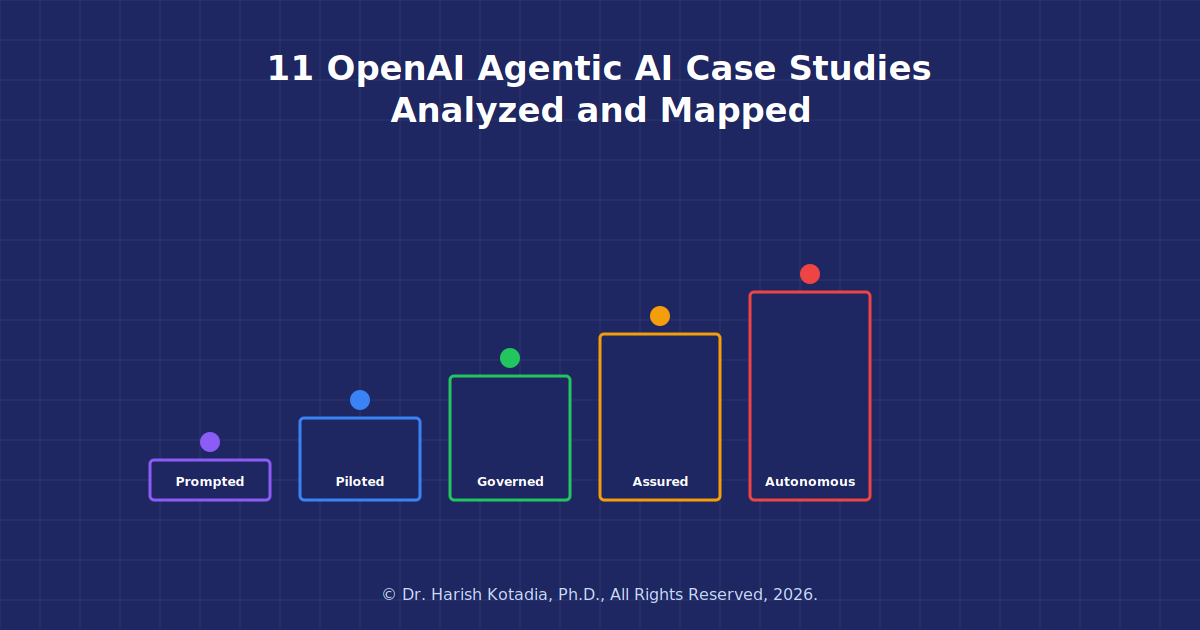
Of the 11 OpenAI case studies analyzed here: 1 sits at Prompted, 3 at Piloted, 3 at Governed, 3 at Assured, and 1 at Autonomous. This is the most evenly distributed maturity spread across OpenAI, AWS, and Claude vendor case studies analyzed in this series. Companies that reach Assured or Autonomous share one trait: they built evaluation frameworks, sandboxing and audit logs before they scaled autonomy, not after.
I pulled these eleven from OpenAI’s customer stories page and mapped each to my Five-Stage Agentic AI Roadmap, the same way I did for AWS and Claude. In the table below, every row states the company, what it built, the underlying stack, and the reported result.
Source: every case study below is drawn from OpenAI Customer Stories (openai.com/business/customer-stories, accessed July 2026). All figures and outcomes are as reported by OpenAI and the named customers.
Where they land on the Agentic AI Roadmap
I plotted all eleven against the five levels of the Agentic AI Roadmap, business function up the side, maturity across the bottom.

Eleven OpenAI customer stories by business function and Agentic AI Roadmap level. Each color marks a level of the Agentic AI Roadmap, violet at Prompted through red at Autonomous.
| Roadmap level | Count | Companies |
|---|---|---|
| Prompted | 1 | Boston Children’s Hospital |
| Piloted | 3 | Nextdoor, Notion, Preply |
| Governed | 3 | BBVA, LSEG, Intercom (Fin) |
| Assured | 3 | NVIDIA, Endava, Morgan Stanley |
| Autonomous | 1 | Travelers |
The most interesting pattern isn’t the lone Autonomous case at Travelers — it’s the convergence at Assured. NVIDIA, Endava, and Morgan Stanley have nothing in common as businesses: a chip maker, an IT services firm, and a wealth manager. Yet all three independently built nearly identical assurance scaffolding before they let autonomy scale. Three unrelated companies arrived at the same answer because the answer is structural, not stylistic.
The companies that reach Assured or Autonomous are never the ones with the most impressive model. They are the ones that did the boring work first — the evals, the sandboxes, the audit logs, the human-in-the-loop review — and then let autonomy follow. Intent in, outcomes out; and in between, the governance that makes the outcomes safe to trust.
© Dr. Harish Kotadia, Ph.D. All Rights Reserved, 2026
Dr. Harish Kotadia, Ph.D., is an Enterprise AI Architect with 20+ years of IT consulting experience serving Fortune 100 clients, specializing in agentic AI systems built on Anthropic Claude, AWS Bedrock, and Google Vertex AI.
Disclaimer: This blog post is based on recent events and news items drawn from reputed media sources and vendor websites available in the public domain and quoted above. This post is intended for educational purposes, to help the enterprise agentic AI community learn from public information on the application and use of agentic AI tools and technology in Fortune 500 companies. Views and opinions expressed here are my own and do not represent those of any employer or client, past or present. The analysis presented is my independent interpretation of published news reports quoted above and does not constitute legal, financial, or consulting advice of any kind.