
Ask ten experts “What is Agentic AI?” and you will get twelve answers.
I know, because I went looking. Over the past few weeks, I systematically reviewed the top 50 definitions of Agentic AI published across peer-reviewed scholarly journals (IEEE Access, Springer’s Artificial Intelligence Review, MDPI Future Internet, F1000Research), the leading industry research firms (Gartner, McKinsey, BCG, Deloitte, MIT Sloan), major technology companies (IBM, Salesforce, Microsoft, Anthropic, Google), and top business publications (The Wall Street Journal, Associated Press, MIT Sloan Management Review).
I have compiled all 50 definitions — each with the exact quote, source, year, and link, formatted in journal-citation style — into a reference compendium. You can read or download the full PDF embedded at the end of this post. Bookmark it; it is the most complete citation-ready collection of Agentic AI definitions I am aware of.
But here is what struck me after reading all fifty: not one of them was written for the people who will actually have to build, deploy, and operate these systems.
What the 50 Definitions Get Right — and What They Miss
The good news first. There is a genuine consensus core. Across academia, consultancies, and vendors, four attributes appear almost universally:
Autonomy — agentic systems operate with minimal or no continuous human supervision. Goal-directedness — they pursue objectives, not isolated prompts. Multi-step reasoning — they plan, decompose, and execute sequences of actions. Adaptability — they respond to feedback, environmental change, and failure states.
Beyond that core, the camps diverge in revealing ways. Academic sources emphasize architecture: cognitive loops, persistent memory, tool use, multi-agent orchestration. The consultancies emphasize organizational identity: Gartner’s “goal-driven digital workforce,” BCG’s “both software and colleague,” MIT Sloan Management Review’s “autonomous teammates.” The technology vendors emphasize trust and guardrails. And the economists at MIT and NBER add something genuinely new: transactional agency — agents that can search, negotiate, contract, and transact on behalf of human principals.
All of this is valuable. And yet, after fifty definitions, four gaps remained wide open:
Gap 1: Nobody speaks to infrastructure people. Every definition describes what agentic AI does. Not one explains what it is in the stack — where it sits relative to the cloud platforms, data pipelines, and application estates that enterprise architects already own and operate.
Gap 2: Nobody addresses the data plane. An entire generation of IT professionals built their careers on Big Data: ingestion, ETL, warehouses, lakes, lakehouses. No definition connects agents to the data architecture they will actually run on — and run on it they will.
Gap 3: Governance is an afterthought, not a definition. Only Gartner’s “within defined guardrails” even gestures at it. But anyone who has shipped systems in a regulated enterprise knows the truth: an ungoverned, unobservable, unauditable system is not deployable — and if it is not deployable, it is not real.
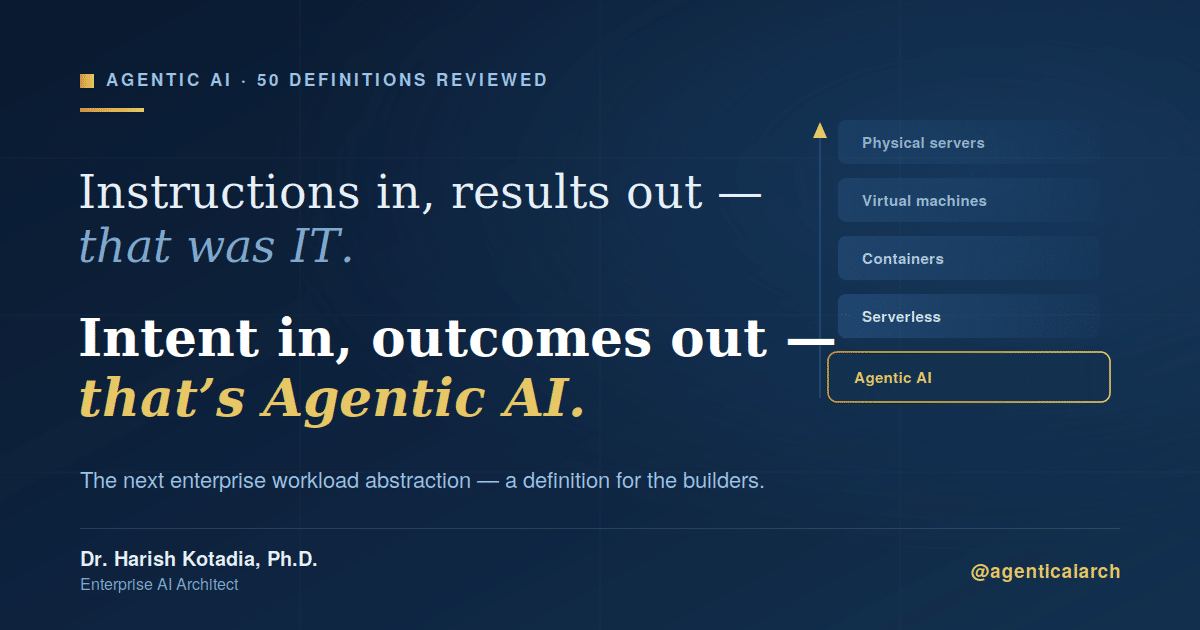
Gap 4: Nobody bridges the workload mental model. IT professionals have climbed a very specific abstraction ladder over twenty-five years: physical servers → virtual machines → containers → serverless functions. Each rung abstracted away more operational toil. Agentic AI is the next rung on that ladder — and not a single one of the fifty definitions frames it that way.
Why I Felt Qualified — and Obligated — to Fill These Gaps
A definition is only as good as the vantage point it is written from.
Mine is a practitioner’s vantage point, earned over more than two decades. I hold a Ph.D. in Marketing Management with doctoral research in marketing analytics — regression modeling and statistical analysis of customer satisfaction, done long before “data science” was a job title. I have spent 20+ years as an Enterprise Systems Architect serving Fortune 100 clients at leading global IT consulting firms — a career that traversed every major wave of enterprise technology: ERP, CRM, Data Warehousing, Business Intelligence, Big Data analytics, and cloud-native platforms on AWS and GCP.
Today I architect agentic AI systems on Anthropic Claude, AWS Bedrock, and Google Vertex AI — including MCP-based multi-agent orchestration with human-in-the-loop review for regulated industries.
That journey matters here, because the audience that most needs a working definition of Agentic AI is the audience making the same journey: the data engineers, cloud architects, platform leads, and analytics veterans who built the Big Data and cloud era and are now being asked to build the agentic era. They do not need another anthropomorphic metaphor about “digital coworkers.” They need a definition that locates agentic AI in the stack they already understand — and connects it to the business outcomes their CIOs are accountable for.
So, drawing on the consensus core of the 50 definitions, and deliberately filling the four gaps they leave open, here is the definition I propose.
A New Definition of Agentic AI — From the Practitioner’s Viewpoint
“Agentic AI is the next enterprise workload abstraction: a governed, goal-driven software layer in which LLM-powered agents — equipped with memory, tools, and orchestration protocols — autonomously plan and execute multi-step business processes across your cloud, data, and application estate, the way containers once abstracted servers and pipelines once abstracted data movement. Where traditional IT systems execute instructions, agentic AI executes intent — converting business objectives directly into governed, observable, auditable action, and converting your existing AWS, GCP, and data platform investments from systems of record into systems of autonomous execution.”
— © Dr. Harish Kotadia, Ph.D., 2026
Let me unpack it, element by element, and explain why each phrase is there.
“The next enterprise workload abstraction”
This is the anchor — and it is the phrase missing from all fifty definitions I reviewed. Every IT professional has lived the abstraction ladder: physical servers gave way to virtual machines, VMs to containers, containers to serverless. Each rung let us stop managing the layer below and start declaring what we wanted from the layer above. Agentic AI is the next rung. With serverless, you stopped managing infrastructure and declared functions. With agents, you stop scripting workflows and declare goals. If you understood the shift from EC2 to Lambda, you already understand the shift to agents — this phrase tells you so.
“A governed, goal-driven software layer”
Two deliberate choices here. First, “governed” comes before “goal-driven.” In forty-nine of the fifty definitions, governance is either absent or appended as a caveat. From the practitioner’s seat — especially in regulated industries like power utilities and financial services, where I have deployed these systems — governance is not a constraint on the definition; it is the definition. An enterprise agent without policy enforcement, access controls, and audit trails is a prototype, not a product. Second, “software layer” keeps us honest: agentic AI is not magic and not a colleague. It is software — extraordinary software, but software — and it should be architected, tested, versioned, and operated like the critical layer it is.
“LLM-powered agents — equipped with memory, tools, and orchestration protocols”
This is the technical anatomy, and each of the three components is load-bearing. Memory is what separates an agent from a stateless chat completion — persistent context across steps, sessions, and processes. Tools are the hands: API calls, database queries, code execution, document generation — the agent’s ability to act on systems rather than merely talk about them. Orchestration protocols — Anthropic’s Model Context Protocol (MCP), Google’s Agent2Agent (A2A) — are the connective tissue that lets agents interoperate with enterprise systems and with each other, the way TCP/IP let networks interoperate. The academic literature got this anatomy right; the business definitions dropped it. A practitioner’s definition keeps it, because this is precisely what you will be architecting.
“Autonomously plan and execute multi-step business processes”
This carries the consensus core of all 50 definitions — autonomy, planning, multi-step execution — but with one practitioner’s correction: the unit of work is the business process, not the “task.” Tasks are what demos automate. Processes are what enterprises run: loan origination, claims adjudication, supply chain exception handling, compliance reporting. The economic case for agentic AI — McKinsey estimates $450–650 billion in additional annual revenue potential by 2030 — lives at the process level, not the task level.
“Across your cloud, data, and application estate”
The word “your” is doing the most important work in the entire definition. Agentic AI does not arrive on a greenfield. It arrives into the estate you have spent fifteen years building: the AWS accounts, the GCP projects, the data lakes, the warehouses, the SaaS sprawl, the APIs. The fifty definitions describe agents in the abstract; this clause locates them in your architecture diagram — which is where every real deployment decision gets made.
“The way containers once abstracted servers and pipelines once abstracted data movement”
An analogy chosen for one audience: the people who lived it. If you containerized monoliths in the 2010s or built ETL and streaming pipelines in the Big Data era, this clause is your bridge. It says: you have done this kind of transition before, and the skills transferred then will transfer now. That is not just rhetoric — it is reassurance grounded in architectural truth. Orchestration, observability, idempotency, failure handling: the disciplines of the container and pipeline era are exactly the disciplines of the agentic era.
“Where traditional IT systems execute instructions, agentic AI executes intent”
This is the conceptual heart — the one-line version you can carry into any boardroom or architecture review. For seventy years, computing has worked one way: humans translate goals into explicit instructions (code, configurations, workflows), and machines execute them. Agentic AI inverts the translation step. You express the objective — “resolve this customer’s billing dispute within policy,” “reconcile these three ledgers and flag exceptions” — and the agent performs the decomposition into steps that we used to do by hand. Instructions in, results out — that was IT. Intent in, outcomes out — that is agentic AI.
“Converting business objectives directly into governed, observable, auditable action”
The triplet here — governed, observable, auditable — is the enterprise deployment bar, stated as part of the definition rather than buried in a risk appendix. Governed: agents operate within policy guardrails and human-in-the-loop checkpoints. Observable: every reasoning step and tool call is logged and traceable, the way we instrument any production workload. Auditable: when the regulator, the CISO, or the post-incident review asks “why did the agent do that?”, there is an answer. Notably, McKinsey’s 2026 research found that 80% of organizations have already encountered risky behavior from AI agents. The definition that wins the enterprise will be the one that makes this triplet non-negotiable from day one.
“Converting your existing AWS, GCP, and data platform investments from systems of record into systems of autonomous execution”
I saved the business-strategy payload for last. For two decades, enterprises have invested billions in systems of record — the databases, warehouses, lakes, and platforms that store and report on the business. The strategic promise of agentic AI is a reframe: those same investments become systems of autonomous execution — platforms that don’t just record what happened, but act on what should happen next. Your data lake stops being a rear-view mirror and becomes a launchpad. For the Big Data and cloud generation, this is the single most important message in the definition: the agentic era does not obsolete your experience or your estate — it activates both.
The Short Versions
For when you need it compact:
The elevator version: “Agentic AI is the next workload abstraction: where traditional IT executes instructions, agents execute intent — turning your cloud and data estate from systems of record into systems of autonomous execution.” © Dr. Harish Kotadia, 2026
The one-liner: “Instructions in, results out — that was IT. Intent in, outcomes out — that’s agentic AI.” © Dr. Harish Kotadia, 2026
A Definition Is a Position
Here is my closing thought. Several of the most credible sources I reviewed — MIT Sloan Management Review, Gartner, and multiple academic surveys — openly acknowledge that there is no universally agreed-upon definition of Agentic AI. Some treat that as a problem. I treat it as an invitation.
When a field’s definitions are still contested, the definition that wins is the one written from the vantage point of the people who must make the technology real. The consultancies have defined agentic AI for the boardroom. Academia has defined it for the lab. This definition is for the builders — the architects, the data engineers, the platform teams — written by one of their own.
Embedded below: the full reference compendium — Agentic AI: Authoritative Definitions, A Curated Citation Compendium of 50 Definitions — with exact quotes, sources, years, and links for every definition cited in this analysis.
Dr. Harish Kotadia, Ph.D., is an Enterprise AI Architect with 20+ years of IT consulting experience serving Fortune 100 clients, specializing in agentic AI systems built on Anthropic Claude, AWS Bedrock, and Google Vertex AI. He holds a Ph.D. in Marketing Management with doctoral research in marketing analytics. Follow him at @agenticaiarch on X and at AgenticAIArch.com.
© Harish Kotadia, 2026. All Rights Reserved.