
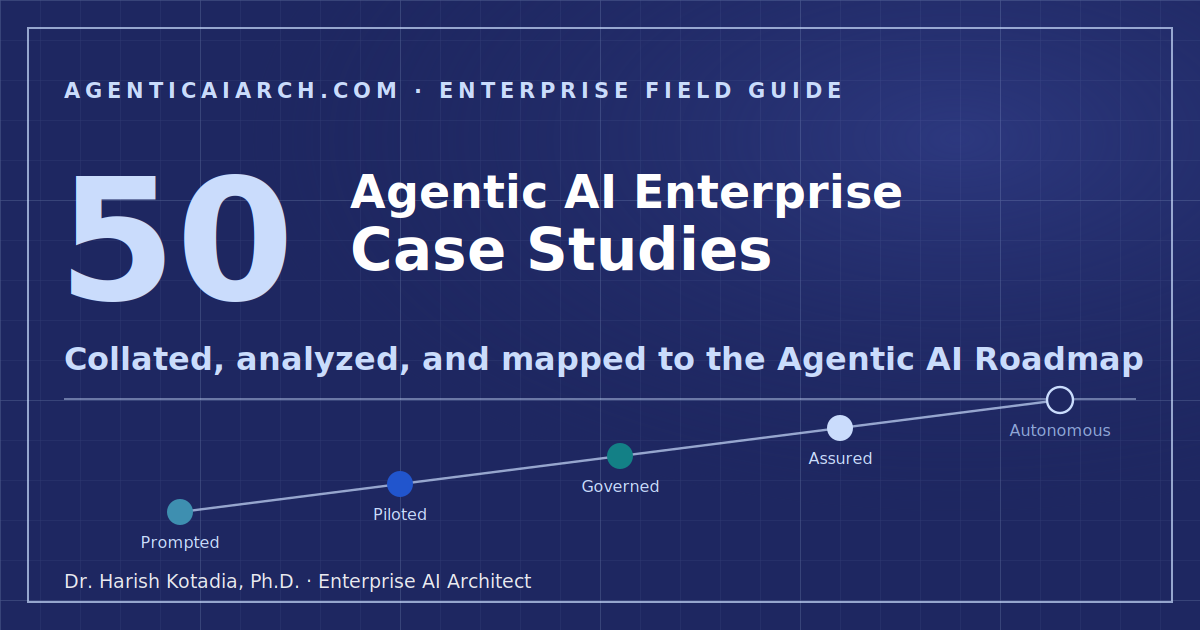
This post has one objective: to collate the enterprise agentic AI deployments worth knowing about, analyze what each one actually achieved, and classify it against the Agentic AI Roadmap I published earlier.
Most agentic AI conversations stall at the pilot. The more useful question is what happens when an agent reaches production and has to deliver against a number. In our own work on auto loan and credit card origination, the pattern is consistent. The agent succeeds when the intent is clear, the data is governed, and a human stays in the loop for the hard edges. Intent in, outcomes out.
Below are fifty deployments that moved past the demo, drawn from vendor case-study libraries, company press releases, and business and trade press. Each entry has the organization, what the agent does and what it returned, and a source link. They are grouped by domain so you can jump to the area that matters to you. After the list, we plot all fifty against the roadmap to see where the market really sits.
One caveat on the numbers. Most of these figures are self-reported by the customer or the platform vendor, not independently audited. Read them as directional signals rather than benchmarks. Where a result depends on the underlying architecture, public disclosure is thin across the industry, which is itself worth noting for any CIO sizing an investment.
Financial services and insurance
1. Klarna AI Assistant. An OpenAI-powered assistant that handled two-thirds of customer service chats in its first month, the equivalent of roughly 700 full-time agents, cutting resolution time from 11 minutes to under 2. Klarna later rebalanced toward more human support for complex cases. Source: Klarna
2. JPMorgan Chase LLM Suite. A platform giving 250,000 employees access to OpenAI and Anthropic models, used for tasks from generating investment-banking presentations to drafting M&A documents and running multi-step processes autonomously. Source: AI Magazine
3. Goldman Sachs. Among the named institutions running Claude in production, with deployment described in three waves, from empowering the technology org to reimagining operational processes end-to-end. Source: Fortune
4. AIG, insurance claims. In an internal benchmark, the AI scored 88% as accurate as a human expert on insurance claims out of the box, framed by leadership as a starting point with room to improve. Source: Fortune
5. Citi Stylus Workspaces. An in-house research assistant powered by Anthropic’s Claude and Google Gemini, with agentic tools added to extend it beyond retrieval into action. Source: CIO Dive
6. Norges Bank Investment Management. Uses Claude for investment-grade financial analysis at institutional scale. Source: Anthropic
7. Commonwealth Bank of Australia. Named among Anthropic’s financial-services clients, alongside AIG and Norges Bank Investment Management, applying Claude inside regulated workflows. Source: Banking Dive
8. FIS Financial Crimes AI Agent. Built with Anthropic to compress anti-money-laundering investigations from days to minutes by assembling evidence across core systems, with BMO and Amalgamated Bank among the first deployments. Source: FIS
9. Robinhood. On Amazon Bedrock, scaled from 500 million to 5 billion tokens daily in six months while cutting AI costs by 80% and halving development time. Source: AWS
10. Clearwater Analytics (CWIC). A Bedrock and SageMaker platform that turned a chat interface into an AI-powered investment console, with faster responses, fewer service tickets, and 20% business growth without adding headcount. Source: AWS
11. Rocket Companies, Rocket AI Agent. Built on Amazon Bedrock Agents for 24/7 home-buying guidance; reported a threefold increase in conversion from web traffic to closed loans, an 85% reduction in transfers to customer care, and 68% customer satisfaction. Source: AWS
12. Commerzbank. A Google Cloud gen AI solution that creates AI-assisted summaries of investment advisory calls with corporate clients, reducing administration time by 66%. Source: Google Cloud
13. United Wholesale Mortgage. Using Google Cloud AI to transform the mortgage experience, more than doubling underwriter productivity. Source: Google Cloud
14. Cotality Payoff Analysis Agent. Helps mortgage lenders improve retention and reduce loan runoff by analyzing originations and payoffs for recapture and competitive insights. Source: Google Cloud
15. Wells Fargo, Fargo assistant. Enhanced its Fargo virtual banking assistant with Google’s Gemini and internal models, expanding agentic capabilities through a broadened Google partnership. Source: CIO Dive
16. 1-800Accountant. Agentforce autonomously resolved 70% of chat engagements during the 2025 tax week, freeing CPAs for higher-value client work. Source: Salesforce
Customer service and contact center
17. ASAPP GenerativeAgent. Built on Claude in Amazon Bedrock; resolves 91% of complex service issues on the first call and reduced call escalation by up to 40%. Source: AWS
18. Williams-Sonoma, “Olive”. An Agentforce deployment where the “Olive” agent handles roughly 60% of conversations on the website. Source: CX Today
19. Engie. Uses Agentforce to answer billing and clean-energy questions and now successfully assists 83% of users. Source: Salesforce
20. Fisher & Paykel. Agentforce grounded on thousands of knowledge articles raised self-service rates from 40% to 70%. Source: Salesforce
21. Nexo. An early Agentforce adopter that reached 62% case resolution after working through data cleanup and technical debt. Source: Salesforce
22. Wiley. Upgraded from a basic chatbot to Agentforce service agents; case resolution improved over 40% in the first weeks, seasonal agents onboarded 50% faster, and ROI reached 213% with $230,000 in documented savings. Source: Salesforce / Cyntexa
23. Yahoo! JAPAN. Agentforce resolves 25,000 customer FAQs per month, with answers grounded in trusted knowledge, order data, and case history. Source: Salesforce
24. Engine. Scaled Agentforce to support one million customers while completing a multi-brand consolidation in ten months. Source: Salesforce
25. LiveX AI. Builds multimodal customer-experience agents on Google Kubernetes Engine and NVIDIA that reduce customer support costs by 85%. Source: Google Cloud
26. TELUS. Uses BigQuery and Gemini Enterprise to automate 30% of customer calls and resolve them 87% faster. Source: Google Cloud
27. Swisscom. Built enterprise agents on Amazon Bedrock AgentCore for customer support and sales, including personalized sales pitches, under Switzerland’s strict data-protection laws. Source: AWS
28. Optus. Launched “Expert AI,” an agentic solution that analyzes live customer conversations in real time, suggests next actions, and executes tasks across backend systems. Source: Current Analysis
Security and IT operations
29. Trellix. Security tooling on Claude in Amazon Bedrock that autonomously analyzes security alerts, saving thousands of hours and achieving 23x cost savings while maintaining 95% accuracy. Source: AWS
30. Druva. Partnered with the AWS Generative AI Innovation Center to build threat-investigation agents operating reliably across more than 7,500 customers’ infrastructures. Source: AWS
31. HackerOne. Using Claude Sonnet to reduce vulnerability response time by 44%. Source: Anthropic
32. Palo Alto Networks. Named among organizations pioneering agentic systems with Claude across teams and workflows. Source: Anthropic
Platform and cross-functional agent fleets
33. ServiceNow. Chose Claude as the default model for its Build Agent; a Claude-powered coaching tool cut seller preparation time by up to 95%, with Claude rolled out across more than 29,000 employees. Source: Anthropic
34. SAP, Joule agents. Embedding Claude across the SAP Business AI Platform so agents can close the books at quarter-end, reroute delayed orders, and approve expenses within existing SAP controls. Source: SAP
35. PwC. Built a portfolio of over 120 production AI agents with Google Cloud spanning 24 cross-functional workflows, each integrated, governed, and auditable. Source: PwC
36. Cox Automotive. On Amazon Bedrock AgentCore with Claude, reporting up to 63% autonomous issue resolution and 58% faster response times. Source: AWS
37. Epsilon. Used Amazon Bedrock AgentCore to automate complex marketing campaign workflows while maintaining enterprise security and compliance. Source: AWS
38. Pets at Home, McKinsey & Co., Thomson Reuters. Among early adopters of Microsoft Copilot Studio and Dynamics 365 autonomous agents that reported efficiency and cost gains, including shorter onboarding and more efficient due diligence. Source: Futurum Group
Manufacturing, energy and industrial
39. AES. Claude models on Vertex AI power safety-audit agents; after 50-plus agent audits, AES reduced audit costs by 99% and cut audit time from 14 days to one hour, with a 10 to 20% accuracy increase. Source: Google Cloud
40. Honeywell. Uses Vertex AI, BigQuery, and Gemini to build product-lifecycle agents that help engineers deliver results up to 70% faster. Source: Google Cloud
41. General Mills. Saves over $100 million using BigQuery and Vertex AI to give employees secure access to gen AI across structured and unstructured data. Source: Google Cloud
42. Unilever. Connects agents end-to-end so procurement teams can make faster, smarter sourcing decisions on a secure foundation. Source: Google Cloud
Healthcare and life sciences
43. Novo Nordisk. Uses Claude to address a clinical-documentation bottleneck where study reports can run 300 pages and writers averaged just 2.3 reports a year. Source: Anthropic
44. MEDITECH. With Google Workspace and Gemini, saves 7 hours per employee per week by reducing manual tasks like notetaking and drafting. Source: Google Cloud
45. MIMIT Health. Uses Salesforce’s Agentic Enterprise Architecture to unify patient data and coordinate care, driving 30% higher patient satisfaction. Source: Salesforce
Retail, telecom, media and professional services
46. Mercado Libre. Deployed Vertex AI Search across 150 million items in three pilot countries, already delivering millions in incremental revenue. Source: Google Cloud
47. Etsy. Enabled Gemini for all employees; support agents now analyze customer insights in 5 to 6 minutes versus the 2 to 4 hours it previously took. Source: Google Cloud
48. Amdocs Telco Customer Experience Agent. Built with Gemini Enterprise to autonomously resolve complex customer-service issues end-to-end across digital and contact-center channels. Source: Google Cloud
49. Cognizant. Built an AI agent on Vertex AI and Gemini to help legal teams draft contracts, assign risk scores, and recommend operational optimizations. Source: Google Cloud
50. Altumatim. A legal-tech platform on Gemini and Vertex AI for eDiscovery that accelerates document analysis from months to hours with over 90% accuracy. Source: Google Cloud
Analysis: the fifty, mapped to the roadmap
Collation is the easy part. The analysis is where the list earns its keep. We plotted all fifty deployments on two axes: business function down the side, and the five levels of the Agentic AI Roadmap across the bottom, from Prompted to Autonomous. Each placement reflects the maturity the case study actually evidences, not the ambition behind it. and Agentic AI Roadmap level. Deployments concentrate at Piloted, thin out toward Assured, and none yet evidence Autonomous.

Fifty case studies placed by business function and Agentic AI Roadmap level. Deployments concentrate at Piloted, thin out toward Assured, and none yet evidence Autonomous.
The shape of the chart is the finding. The mass sits at Piloted. These are real agents doing real work in bounded settings, but with little public evidence that the discipline has been institutionalized beyond the project. That matches what we see in the field, and it is why so many agentic programs quietly stall: the pilots never industrialize.
A smaller cluster reaches Governed, where there is evidence of a standardized, institutional approach rather than a one-off. Only two cases in the set reach Assured, where agent behavior is measured against targets and the audit trail is built to satisfy an examiner. The clearest examples are a financial-crimes agent whose evidence trails exist precisely for regulators, and a professional-services firm running a fleet described as governed and auditable. Not one deployment in fifty publicly evidences Level 5, Autonomous.
At the other end, a few cases sit at Prompted. These are enterprise copilots rolled out to employees, valuable but not yet task-specific agents in production. Keeping them honestly at Level 1 matters, because the gap between a copilot and a governed agent is exactly the gap the roadmap is built to measure.
Read the columns left to right and the deployments thin out as the bar shifts from can it run to can we prove it is in control. That is the roadmap’s central claim made visible. You do not reach the higher levels by removing controls. You earn autonomy by first earning assurance. In our origination projects the lesson repeats: the model is rarely the constraint. The constraint is whether the intent, the data, and the controls are clear enough for the outcome to be trusted. Intent in, outcomes out.
Before you benchmark against any of these stories, place yourself honestly on the roadmap, not by your best pilot but by your weakest production agent. See the five levels of the Agentic AI Roadmap.
© Dr. Harish Kotadia, 2026. All Rights Reserved.
Dr. Harish Kotadia, Ph.D., is an Enterprise AI Architect with 20+ years of IT consulting experience serving Fortune 100 clients, specializing in agentic AI systems built on Anthropic Claude, AWS Bedrock, and Google Vertex AI. He holds a Ph.D. in Marketing Management with doctoral research in marketing analytics. Follow him on LinkedIn at www.linkedin.com/in/hkotadia and at AgenticAIArch.com.