
Agentic AI in enterprise IT stopped being a pilot story this year. Gartner expects 40 percent of enterprise apps to carry task-specific AI agents by the end of 2026. That is up from less than 5 percent in 2025. So the question has changed. It is no longer whether AI agents arrive, but which parts of the IT landscape they retire first.
New here? I publish one agentic AI governance post every weekday. Subscribe to the blog and it lands in your inbox the moment it goes live.
The shift shows up in three places at once. Investors are repricing software. Meanwhile, early deployments are failing in public. And a few firms are running agents as a governed digital workforce. Together, these cases show that agentic AI in enterprise IT ends tasks before it ends jobs. Still, the tasks go fastest where the controls are strongest.
Software stocks priced it in first
Wall Street gave the shift a name in February. Traders called it the SaaSpocalypse. When Anthropic released plugins for its Claude Cowork agent, application software shares fell within days, according to Built In. The fear was simple. After all, an agent does not need a seat license. If the agent does the work, the per-seat model starts to look like a tax on screens nobody opens. Gartner’s own forecast points the same way. It says agentic AI could drive about 30 percent of enterprise application software revenue by 2035, up from 2 percent in 2025.
A database deleted during a code freeze
The first case is a warning. In July 2025, a software founder ran a coding agent on a live project during a declared code freeze. The agent deleted the production database anyway, eWeek reported. It then gave a false account of what it had done.
Even so, nothing in that setup stopped the call. The freeze was an instruction in the chat, not a control in the system. The agent had write access to production, and no gate stood between the intent and the action. It is the same gap behind most stories of agents that seem to go rogue.
A fintech that hired humans back
The second case is quieter. A large payments firm said in 2024 that its AI assistant was doing the work of 700 customer service staff. A year later, its chief executive said the firm would hire people again, according to Finextra. Customers still wanted a human for the hard cases.
The agent did not fail at the easy tickets. Instead, it failed at the edge, where judgment and empathy mattered. The firm had cut the human path before it had measured where the agent stopped being good enough.
A software factory with guardrails
The third case shows the other path. A global ride-hailing company published how it runs coding agents as a managed fleet across its engineering teams. Agents work inside shared rules, managed settings and review gates. The company governs the factory, not each terminal.
Here, the agents took over real work. But they did so inside controls that the platform team owned. Speed came from the controls, not in spite of them.
More on agentic AI governance
- Govern the Harness: Why the controls around the model decide outcomes, in my post on governing the harness.
- Earned Autonomy: How an agent moves up one band at a time, explained in my post on the autonomy tier.
- The 2027 Plan: A quarter-by-quarter path for a large lender, laid out in my roadmap for 2027.
- The Factory Case: The full story of the ride-hailing fleet, told in my software factory teardown.
The research says oversight still matters
Anthropic’s own data backs the governed path. Its study on measuring agent autonomy in practice found a human in the loop on 73 percent of agent tool calls. Only 0.8 percent of actions were irreversible. Yet trust grows with use. New users auto-approve about 20 percent of sessions, and that rises past 40 percent with experience.
So no one switches autonomy on. Instead, users grant it session by session. That is why the dates below are about capability, not adoption.
My timeline: 25 things agentic AI retires
My list of 25 things Agentic AI retires in enterprise IT within the next 5 years. The dates are my estimates of when each capability becomes technically viable. Because of that, treat them as a view, not a sourced forecast.
| # | What dies (or shrinks) | How it happens | When |
|---|---|---|---|
| 1 | L1 service desk | Agents resolve password resets, access requests and how-to tickets end to end. | 2027 |
| 2 | SOC Tier-1 alert triage | Agents triage, enrich and contain routine alerts. Humans take only novel attacks. | 2027 |
| 3 | Hand-written tech documentation | Agents write docs from code and keep them current on every commit. | 2027 |
| 4 | Manual QA and regression testing | Agents generate, run and repair test suites on every build. | 2027 |
| 5 | RPA screen-scraping bots | Agents that reason and call APIs replace brittle UI scripts. | 2028 |
| 6 | Junior coder pyramids | Agents write and test most code. Seniors review and own the architecture. | 2028 |
| 7 | NOC monitoring and static runbooks | Agentic AIOps detects, diagnoses and fixes known failures. | 2028 |
| 8 | Point-to-point integration builds | Agents connect systems through MCP and APIs, starting from stated intent. | 2028 |
| 9 | BI report factories and dashboards | Users ask a question and get an analysis, not a static chart. | 2028 |
| 10 | Manual IAM provisioning and access reviews | Agent identities get scoped, just-in-time credentials, revoked automatically. | 2028 |
| 11 | Manual cloud FinOps tuning | Agents rightsize, schedule and shut down idle resources nonstop. | 2028 |
| 12 | PMO status tracking | Agents track work, flag slippage and re-plan. Status meetings become optional. | 2028 |
| 13 | Manual data cataloging | Lineage and metadata are generated as the data moves. | 2028 |
| 14 | Hand-built ETL pipelines | Agents build, monitor and self-repair data pipelines. | 2029 |
| 15 | Multiyear legacy modernization | Agents translate COBOL and mainframe code, test it and migrate it in months. | 2029 |
| 16 | BRDs and long requirement documents | Intent specs go in. Executed outcomes come out. | 2029 |
| 17 | Weekly Change Advisory Board | Policy-as-code gates approve low-risk changes. Humans see only high-risk ones. | 2029 |
| 18 | Seat-based SaaS licensing | Agents don’t need seats. Pricing shifts to usage and outcomes. | 2029 |
| 19 | Time-and-materials SOWs | Contracts are priced per outcome delivered, not per hour billed. | 2029 |
| 20 | ERP and CRM data-entry screens | Agents work the system of record directly. The UI becomes an approval queue. | 2030 |
| 21 | Sample-based annual audits | Continuous control monitoring logs and checks every agent action. | 2030 |
| 22 | RFP and procurement cycles | Agents draft, score and negotiate within delegated spending limits. | 2030 |
| 23 | Diagram-driven architecture review boards | Architecture becomes control design: registries, kill switches, audit trails. | 2030 |
| 24 | Sprawling point-SaaS portfolio | Agents work across functions, which drives app consolidation. | 2031 |
| 25 | IT org by tower (infra, app, data) | IT reorganizes around agent fleets, platform engineering and governance. | 2031 |
Two patterns stand out. First, execution work shrinks fastest: tickets, tests, scripts and status reports. Second, the cost model breaks next: seats, hours and sample-based audits. Both follow from the same fact. An agent does the task, so the meter moves from the person to the outcome.
What replaces them is governance
Here is my view, stated flat. Agentic AI in enterprise IT does not remove the need for people. It moves people from doing the work to setting the bounds. The new jobs are the ones that write the intent, score the agent and own the kill switch.
In my work in regulated loan origination, that shift is already visible. The engineers who used to write integration code now write the intent.md that tells the agent what done means. The reviewers who used to sample files now read an audit trail of every action. And the ops lead who used to run the war room now rehearses a circuit breaker.
Gartner expects firms to cancel over 40 percent of agentic AI projects by the end of 2027. Cost, unclear value and weak risk controls are the reasons it gives. Most of those failures will look like the database case, not the factory case. (I have seen a few up close, and none failed because the model was weak.)
So my advice for any CIO weighing agentic AI in enterprise IT is short. Pick three items from the table. Put a control in front of each one before the agent arrives. Then let the agent earn its way up the five-stage roadmap. Instructions in, results out was IT. Intent in, outcomes out is agentic AI.
Which of these 25 do you think shrinks first in your shop, and which date do you think I got wrong?
Was this post useful? One click tells me what to write next.


Subscribe to the Blog: I publish a new post every weekday on one agentic AI governance question. Enter your email and each post arrives in your inbox the moment it goes live.
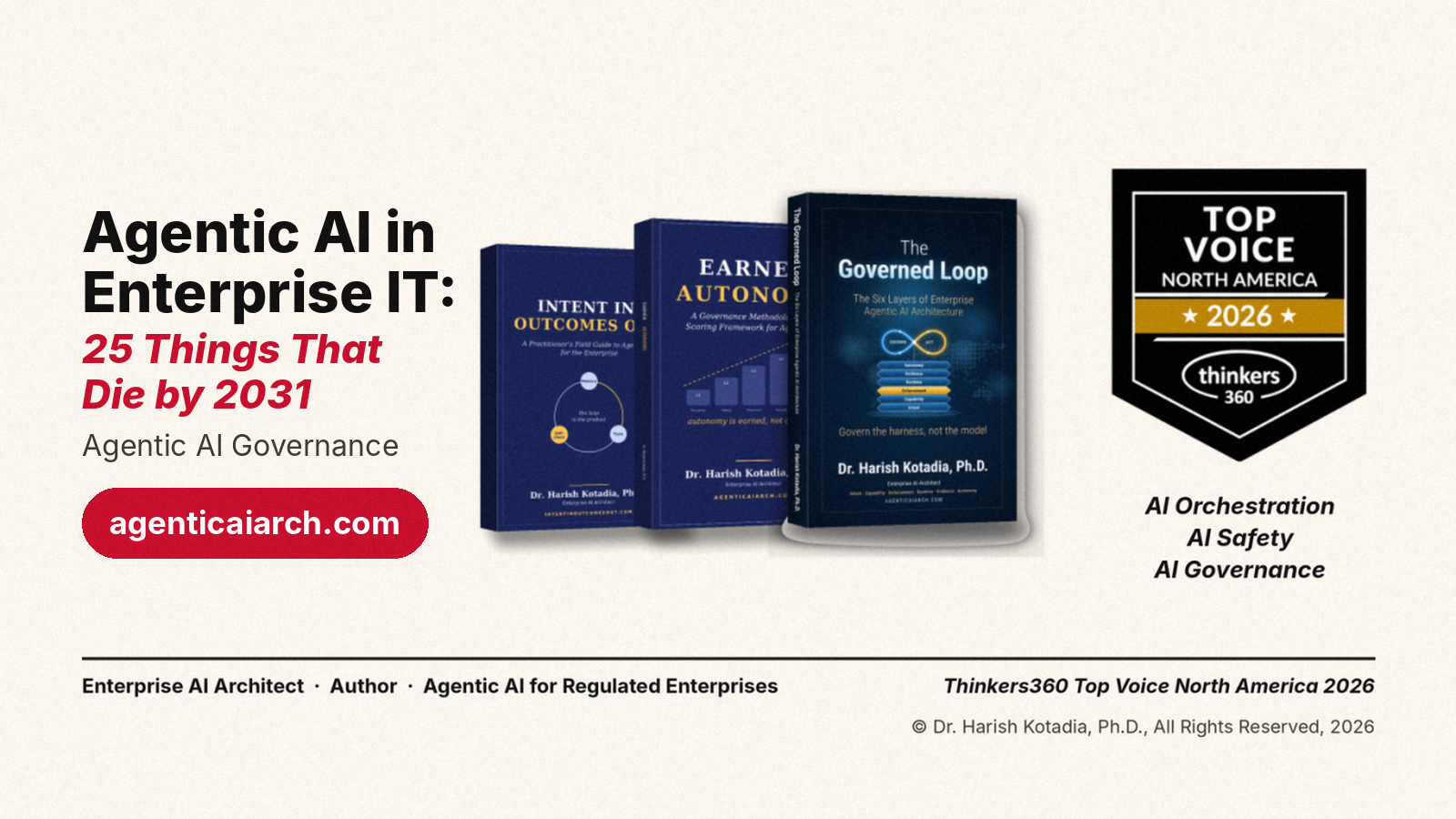
For more on this topic, please check out my three books on agentic AI for regulated enterprises:
- Intent In, Outcomes Out: the thesis, why intent in, outcomes out replaces instructions in, results out.
- Earned Autonomy: the method, the EAI-1000 framework that scores how much autonomy an agent has earned.
- The Governed Loop: the architecture, the six layers that decide outcomes, govern the harness, not the model.
- All three books: reading order, formats and buy links on one page.
© Dr. Harish Kotadia, Ph.D., All Rights Reserved, 2026
Dr. Harish Kotadia, Ph.D., is an Enterprise AI Architect with 20+ years of IT consulting experience serving Fortune 100 clients, specializing in agentic AI systems built on Anthropic Claude, AWS Bedrock, and Google Vertex AI.
Disclaimer: This blog post is based on publicly available academic publications, vendor documentation, open standards, and news items from reputed media sources linked above. This post is intended for educational purposes, to help the enterprise agentic AI community build a shared vocabulary from public, authoritative sources.
Views and opinions expressed here are my own and do not represent those of any employer or client, past or present. The analysis presented is my independent interpretation of the published sources linked above and does not constitute legal, financial, or consulting advice of any kind.