
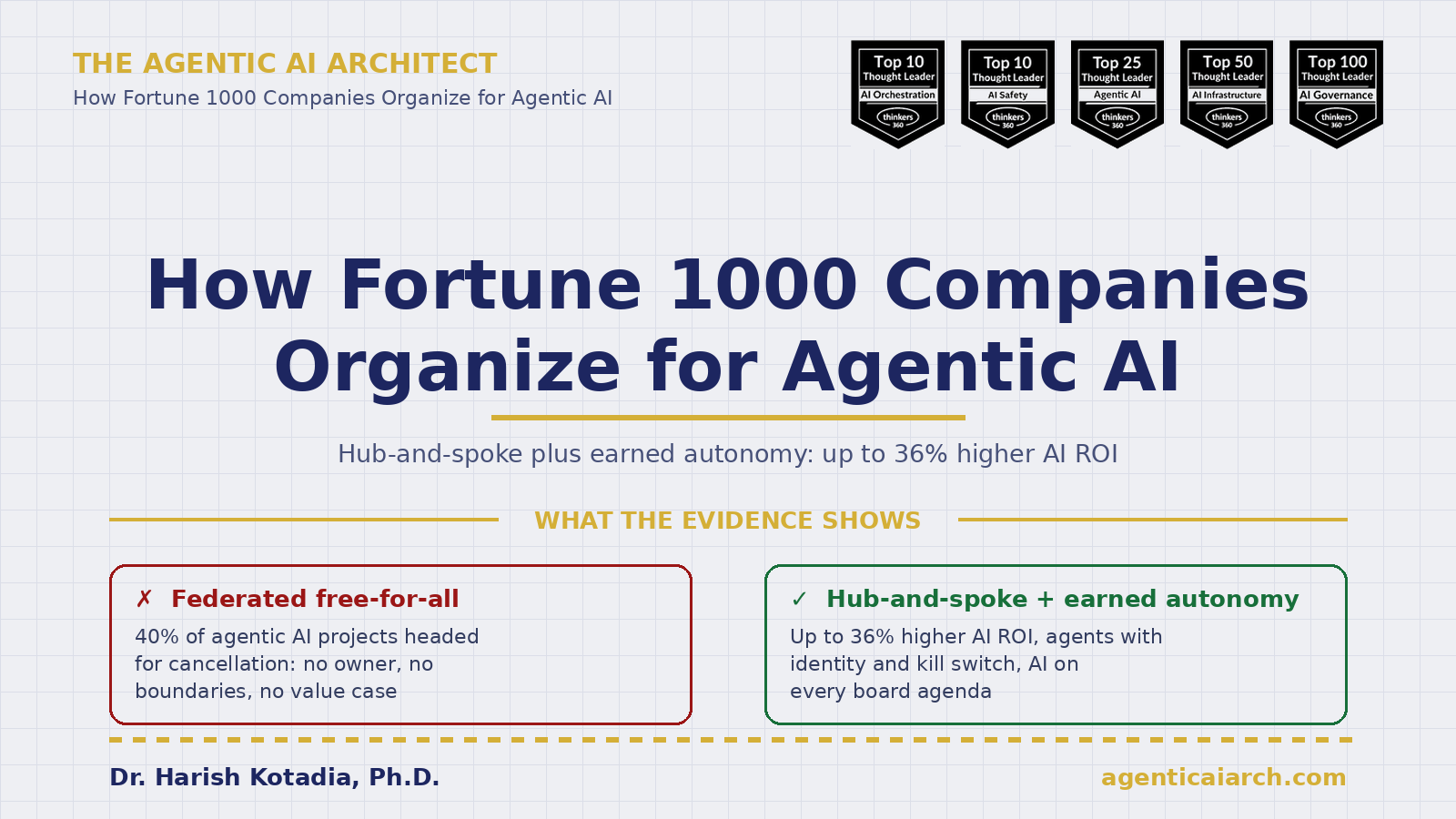
Fortune 1000 companies organize for agentic AI in one of three ways: a centralized AI Center of Excellence, fully embedded teams inside business units, or a hub-and-spoke hybrid that combines both. The published evidence now points clearly at the hybrid. IBM’s study of more than 600 Chief AI Officers across 22 countries found that organizations running a centralized or hub-and-spoke operating model realize up to 36% higher ROI on AI spend than decentralized ones. That is not a rounding error. That is the difference between a program that compounds and a program that quietly gets defunded.
I have spent the past year building and studying agentic AI systems for loan origination, and I keep seeing the same thing: the technology is rarely what kills these projects. The organization is. So I went through the analyst research, the business journals, and the trade press to answer one question — how are large enterprises actually structuring themselves for agentic AI, and which setup is winning?
The Three Operating Models
Every large enterprise I have looked at lands in one of three structures:
- Centralized AI Center of Excellence: One team owns strategy, standards, platforms, and delivery. This works early, when you have more demand than discipline. It breaks later, when the central team becomes the bottleneck every business unit is waiting on.
- Embedded or federated teams: AI talent sits inside business units, close to the domain and fast on its feet. The catch: without a central spine, you get twelve teams solving the same problem twelve ways, and nobody can tell the board what agents are actually running in production.
- Hub-and-spoke: A central hub owns the platform, the standards, and the oversight function. Embedded spokes in the business units build and ship inside those guardrails. Central control, federated speed.
Hub-and-spoke has become the default for mature programs, and I think it deserves to be. McKinsey’s work on the agentic AI advantage makes the same point from a different angle: the companies capturing value are the ones that redesigned the operating model around agents — a cross-functional council setting direction, shared infrastructure, value tracked against actual KPIs — instead of letting a hundred pilots bloom and hoping.
The New Leadership Layer
Three structures show up again and again in the companies getting this right.
The Chief AI Officer. The role has gone from novelty to standard. In IBM’s research, a majority of CAIOs now report directly to the CEO or the board — and organizations with a CAIO in place see roughly 10% greater ROI on AI investments overall, before you even get to operating-model effects.
The AI council. A cross-functional steering group — business leaders, the CIO, the CDO, increasingly the CHRO — that decides what gets built, what gets killed, and what “value” even means. Without it, agentic AI becomes a collection of science projects.
Board engagement. This one surprised me with how strong the signal is. Protiviti’s global survey of 772 board members and executives found that 63% of high-ROI organizations discuss AI at every single board meeting. Among low-ROI organizations? 13%. Correlation is not causation, but a five-fold gap on the same behavior is hard to wave away. Boards that treat AI as a quarterly agenda item get quarterly-agenda-item results.
What Agentic AI Adds That Generative AI Never Demanded
Here is where most 2024-era AI governance falls apart. A chatbot that drafts an email is a content problem. An agent that moves a loan file, calls a pricing API, or releases funds is an actor in your systems — and actors need what employees need. Identity. Boundaries. Supervision. Accountability.
The organizations ahead of the curve are standing up four things:
An agent registry. A single inventory of every agent in production — who owns it, what it can touch, what it is for. If you cannot produce this list on demand, you do not have an agentic AI program. You have a shadow workforce.
Agent identity management. Non-human identities already vastly outnumber human users inside the modern enterprise, and the ratio is climbing fast as agents proliferate. Yet Okta’s research found that while 91% of organizations use AI agents, only about 10% have any strategy for managing them. Every agent needs a unique identity, a named human owner, least-privilege permissions, and a kill switch. Every one.
An AgentOps function. Observability, tracing, evaluation, drift monitoring, rollback. The operational control plane that tells you what your agents did, not what you hoped they would do. Gravitee’s State of AI Agent Security survey of 900-plus practitioners found that barely 47% of an organization’s agents are actively monitored at all. More than half are running blind.
Staged autonomy. This is the design pattern I care most about, and it maps directly to the Five-Stage Agentic AI Roadmap I use in my own work. New agents start with a human reviewing everything. They graduate to exception-based review when the numbers earn it. Only after documented, incident-free production performance do they move to human-on-the-loop, where they act and a human monitors. Autonomy is earned, case by case, with automatic demotion on incidents. I wrote a whole book on this — Earned Autonomy — because I believe it is the single most important governance decision in agentic AI, and most enterprises are still treating it as an afterthought.
The Evidence: Which Setup Actually Wins
Now the uncomfortable numbers. Gartner predicts more than 40% of agentic AI projects will be canceled by the end of 2027, citing escalating costs, unclear business value, and inadequate risk controls. MIT’s GenAI Divide research found that 95% of enterprise generative AI pilots deliver no measurable P&L impact — and, notably, that externally partnered builds succeed at roughly twice the rate of internal-only builds.
Read those failure causes again. Cost discipline. Value definition. Risk controls. Integration. Not one of them is a model-capability problem. They are all operating-model problems. Which is exactly why the organizational data and the failure data tell the same story from opposite ends:
Hub-and-spoke beats pure centralization and pure federation on ROI. Board-level attention correlates with returns at a five-to-one ratio. Scoped, workflow-integrated deployments with earned autonomy survive; open-ended “deploy an agent and see” projects end up in Gartner’s 40%. Intent in, outcomes out — and the operating model is what converts one into the other.
What This Looks Like in Loan Origination
Financial services is running the most instructive experiments, because the cost of an agent being wrong is real money and real customers. A few cases from the trade press, anonymized here with sources linked:
The largest US bank by assets has rolled its LLM platform out to well over 100,000 employees and is pursuing hundreds of agentic use cases — under a C-suite-led AI governance council with an explicit human-in-the-loop mandate. Governance was built into the platform from day one, not bolted on after the first incident.
Another top-five US retail bank is equipping over 200,000 employees with agentic tooling for contract summarization, client onboarding checks, and supervised branch tasks — and has said plainly it has no near-term plans for fully autonomous agents. Strict escalation rules, full audit trails, oversight boards reviewing what agents are allowed to do. That is not timidity. That is staged autonomy done in public.
The largest US mortgage lender automates the majority of its income verification and document classification at massive monthly volume — while the credit decision itself stays inside validated underwriting systems with human underwriters. Agents own the workflow. Humans own the decision. That split is, in my view, the winning pattern for loan origination right now.
Deloitte’s agentic AI research describes the same posture at a global insurer: only low-risk tasks are delegated to agents, anything consequential routes to a human, hybrid by design. Different industry, same architecture of trust.
Where I Land
If I were advising a Fortune 1000 CIO, the sequence would be short. Stand up the hub: a central function that owns the agent registry, the platform, and the autonomy standards. Put spokes in the business units so domain teams ship inside those guardrails instead of around them. Give every agent an identity, an owner, and a kill switch before it touches production. Start every agent at full human review and make it earn its way up. And put agentic AI on every board agenda — not because it is fashionable, but because the data says the companies that do this get paid and the companies that don’t get canceled projects.
The deeper argument — why intent specification and outcome assurance, not model choice, decide who wins — is the subject of my book Intent In, Outcomes Out. And if you are still working out what qualifies as agentic AI in the first place, start with my definition post.
Instructions in, results out was IT. Intent in, outcomes out is agentic AI. The operating model is the machinery in between — and right now, it is the machinery most enterprises have not built.
Go deeper with my newsletters:
- Agentic AI Architect — architecture and control design for enterprise agents
- Agentic AI Case Studies — deployment evidence and ROI teardowns
- Agentic AI P&L — cost, payback, and unit economics
- Agentic AI Governance — where autonomy meets accountability
© Dr. Harish Kotadia, Ph.D., All Rights Reserved, 2026.
Dr. Harish Kotadia, Ph.D., is an Enterprise AI Architect with 20+ years of IT consulting experience serving Fortune 100 clients, specializing in agentic AI systems built on Anthropic Claude, AWS Bedrock, and Google Vertex AI.
Disclaimer: This blog post is based on publicly available academic publications, vendor documentation, open standards, and news items from reputed media sources linked above. This post is intended for educational purposes, to help the enterprise agentic AI community build a shared vocabulary from public, authoritative sources.
Views and opinions expressed here are my own and do not represent those of any employer or client, past or present. The analysis presented is my independent interpretation of the published sources linked above and does not constitute legal, financial, or consulting advice of any kind.