
I have spent over twenty years installing software so that business people could look at their own customer data. I mean that literally. Some of my earliest projects involved putting a CRM client on individual desktops, one machine at a time, before a salesperson could see a single account they already owned. That should sound strange to you. It took me a long time to find it strange too.
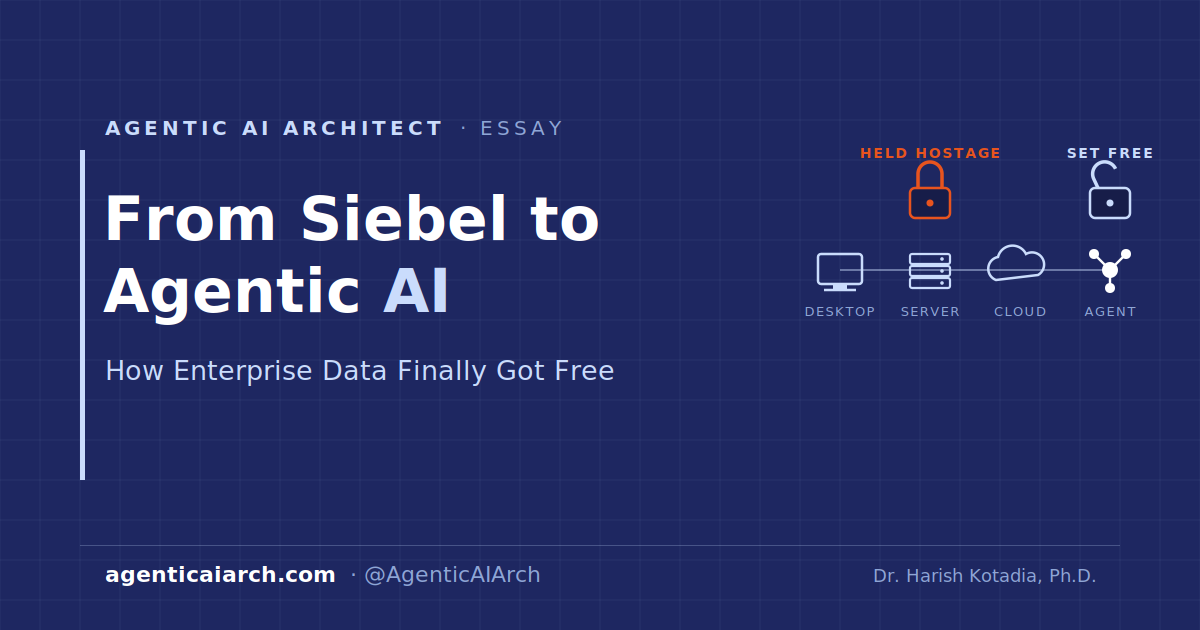
This is a post about why that happened, and why it is finally ending. Enterprise data has been held hostage for twenty-five years, not by any one villain, but by the architecture itself. Every era added a new captor: the desktop, the database schema, the data warehouse, the cloud pipeline. Agentic AI is the first technology I have worked with that actually lets the hostage go.
The desktop years: Siebel and the locked room
In the early 2000s, if your company ran Siebel for sales and customer care, getting a salesperson access to their own pipeline meant a real project. Siebel Dedicated Client had to be installed on the desktop itself, machine by machine, by someone from IT. The data lived in a relational database on a server the business never saw and would not have known what to do with if they had. Every screen, every workflow, every field a rep could see or edit had to be configured first, usually in Siebel Tools, usually by a consultant like me.
None of this was incompetence. The technology genuinely required it. A relational schema only gives you back what you defined in advance, in the shape you defined in advance. If the business wanted a new view of a customer, someone had to model it, build it, test it, and migrate it. The business owned the customer relationship. The technology team owned the only door into the data about that relationship.
The web years: a bigger room, still locked
Siebel and PeopleSoft both eventually moved to a web architecture: an application server, a web server, a browser instead of a desktop client. This was a real improvement. Rolling out to a thousand users no longer meant a thousand desktop installs. But the room only got bigger. The configuration still happened in code and scripted business rules. The business still could not change what it could see or do without a development cycle behind it. We had removed the desktop install and kept everything else.
Big data, the cloud, and a more comfortable cage
The next shift was real, too, and I lived through this one from the data side. Big data broke the rule that data had to fit a predefined schema before it was allowed to exist. Hadoop and the data lakes that followed let you store data in its native, messy, original form and decide what shape to give it later. The industry’s own shorthand for this captures it well: we went from ETL, transform the data before you load it, to ELT, load it first and transform it on demand. Storage got cheap enough that you no longer had to know your questions in advance.
Then the data, and the processing with it, moved off physical servers we managed ourselves and into the cloud. This was progress. It was also, if I am honest, a more comfortable version of the same cage. The data was easier to store and process, but a business user still could not walk up to it directly. Someone still had to build the pipeline, model the warehouse, write the query, build the dashboard, and then train a room full of people on how to read that dashboard and decide what to do about it. We had moved the lock. We had not removed it.
Agentic AI: the door finally opens
Here is what is actually different this time. Every prior era reduced the cost of building the system between intent and outcome. Agentic AI is the first one that removes the system from that sentence entirely. I have written elsewhere about what I mean by agentic AI, and the short version is the same thesis I keep coming back to on this blog: intent in, outcomes out. A business person states the outcome they want. An agent plans the steps, takes the actions, and gets there, without a developer in the loop and without the business person needing to understand the database underneath any of it.
Go back to CRM, because the arc is the clearest there. Siebel needed a desktop install and a configuration project before a salesperson could see an account. PeopleSoft and the web generation of Siebel needed a browser and a development cycle. Salesforce, in the 2010s, finally made configuration mostly declarative: clicks instead of code, an admin instead of a consultant, a real leap forward. But it was still configuration. A human still had to design the workflow before the system could run it.
An agentic CRM does not wait for that workflow to be designed. Tell it the outcome: win back this account before renewal, find the ten clients most likely to churn this quarter, draft and send a recovery sequence to anyone who has gone quiet. The agent reads the account history, decides what needs to happen, and does it: drafts the outreach, updates the record, schedules the call, escalates the one case that actually needs a human. Nobody configured a workflow for “win back this account.” Nobody needed to.
That is the actual difference between this shift and every shift before it. Big data democratized storage. The cloud democratized infrastructure. Agentic AI is the first one that democratizes the outcome itself, for anyone in the business, not just the people who can write a query or read a dashboard.
I do not think this makes the technology team obsolete. Someone still has to earn the trust that lets an agent touch a customer record unsupervised, and that is most of what I write about on this blog: governance, assurance, the work that has to happen before autonomy is safe to grant. But the long captivity is over. For the first time in my career, the person who owns the customer relationship can get the outcome they want without first convincing someone else to build the door.
© Dr. Harish Kotadia, 2026. All Rights Reserved.
Dr. Harish Kotadia, Ph.D., is an Enterprise AI Architect with 20+ years of IT consulting experience serving Fortune 100 clients, specializing in agentic AI systems built on Anthropic Claude, AWS Bedrock, and Google Vertex AI. He holds a Ph.D. in Marketing Management with doctoral research in marketing analytics. Views expressed are the author’s own and do not represent that of any employer or client. Follow him on LinkedIn at www.linkedin.com/in/hkotadia and at AgenticAIArch.com.