
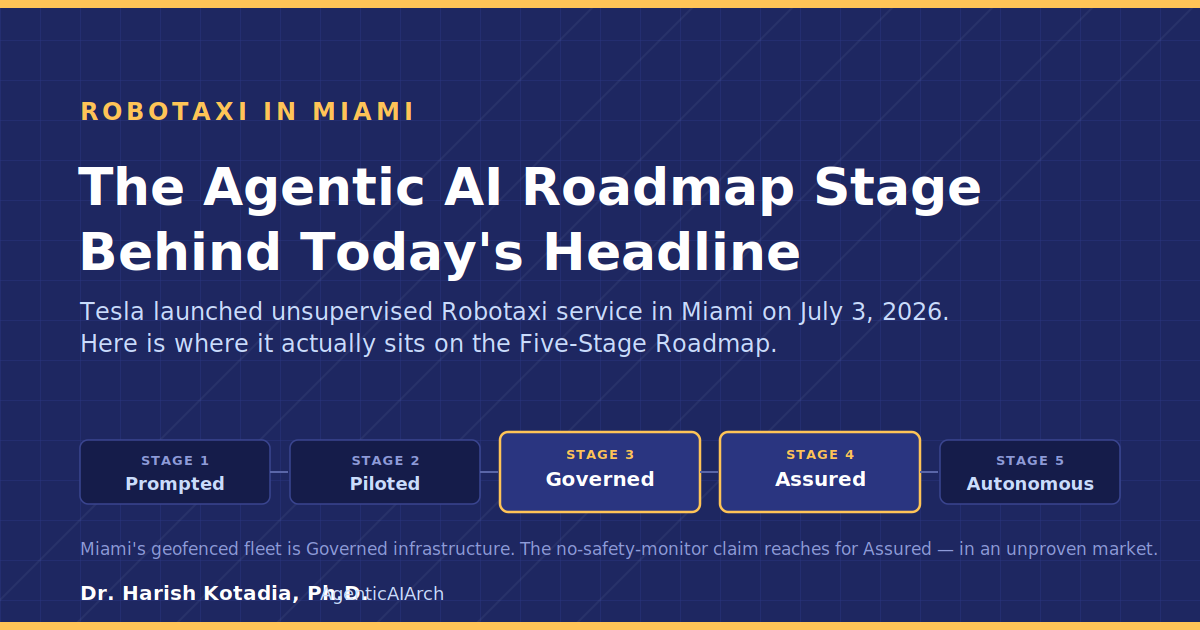
Tesla turned on unsupervised Robotaxi service in Miami. No safety monitor in the seat, live in a geofenced zone covering West Miami, Doral, and Coral Gables. Florida is now the first state outside Texas to get it, and Miami is the fourth city in the network after Austin, Dallas, and Houston.
I read that headline through the lens of the Five-Stage Agentic AI Roadmap I laid out in my last post. It is a useful test case, because the roadmap was built on Tesla FSD in the first place, and today’s news is the roadmap playing out in real time in a brand-new market.
What Actually Launched Today
The Miami service runs on a fleet of Model Y vehicles inside a fixed geofence of roughly 10 to 14 square miles, covering high-traffic corridors near Miami International Airport. Riders book through the dedicated Robotaxi app. There is no driver and, unlike Tesla’s earliest Austin rides, no human safety monitor riding along either. That last detail is the one worth sitting with.
Governed Infrastructure, Assured Ambition
A geofenced fleet, a single operator watching the whole system, a mapped zone with defined boundaries — that is Stage 3 on my roadmap, Governed. It is the same shape as Austin, Dallas, and Houston before it. Nothing about that part is new, and Tesla has clearly gotten efficient at replicating it city to city.
The no-safety-monitor detail is a different claim entirely. That is a reach toward Stage 4, Assured, where the system has earned enough validated performance data that a human no longer needs to sit in the loop as a backstop. Tesla earned that posture in Texas over roughly a year of runs, a string of incident reports filed with NHTSA, and enough accumulated mileage to argue the numbers hold up. Miami has none of that history yet. Same software stack, same FSD build, zero driving record in this market.
That is the gap I keep coming back to across every agentic system I have shipped. The interface says autonomous. What is actually running underneath is supervised at a distance, with trust that has to be earned again in every new context, not inherited from the last one.
Why This Matters Beyond Cars
I see the same pattern constantly in regulated enterprise AI. An agent that clears every check in one loan origination workflow does not automatically carry that clearance into a new state, a new product line, or a new regulator’s jurisdiction. The model does not change. The assurance case has to be rebuilt anyway, because the conditions changed and the old evidence does not speak to the new ones.
Miami will be a real test of that principle, not a hypothetical one. Higher humidity, denser airport traffic, a different rider base, and roads Tesla’s stack has never driven at scale. If the system performs the way it did in Texas, that is genuine evidence the roadmap is generalizing. If it does not, that is evidence too, and it will show up in NHTSA filings the same way the Austin issues did.
Either way, the lesson for anyone building agentic systems in a regulated industry is the same one I keep repeating: autonomy is not a switch you flip once and reuse everywhere. It is a ledger you keep refilling, market by market, workflow by workflow, until the data says otherwise.
For the full breakdown of all five stages and how they map onto Tesla FSD’s public rollout, read my Agentic AI Roadmap post.
© Dr. Harish Kotadia. All Rights Reserved, 2026.
Dr. Harish Kotadia, Ph.D., is an Enterprise AI Architect with 20+ years of IT consulting experience serving Fortune 100 clients, specializing in agentic AI systems built on Anthropic Claude, AWS Bedrock, and Google Vertex AI. He holds a Ph.D. in Marketing Management with doctoral research in marketing analytics. Views expressed are the author’s own and do not represent that of any employer or client. Follow him on LinkedIn at www.linkedin.com/in/hkotadia and at AgenticAIArch.com.
© Dr. Harish Kotadia, 2026. All Rights Reserved.