
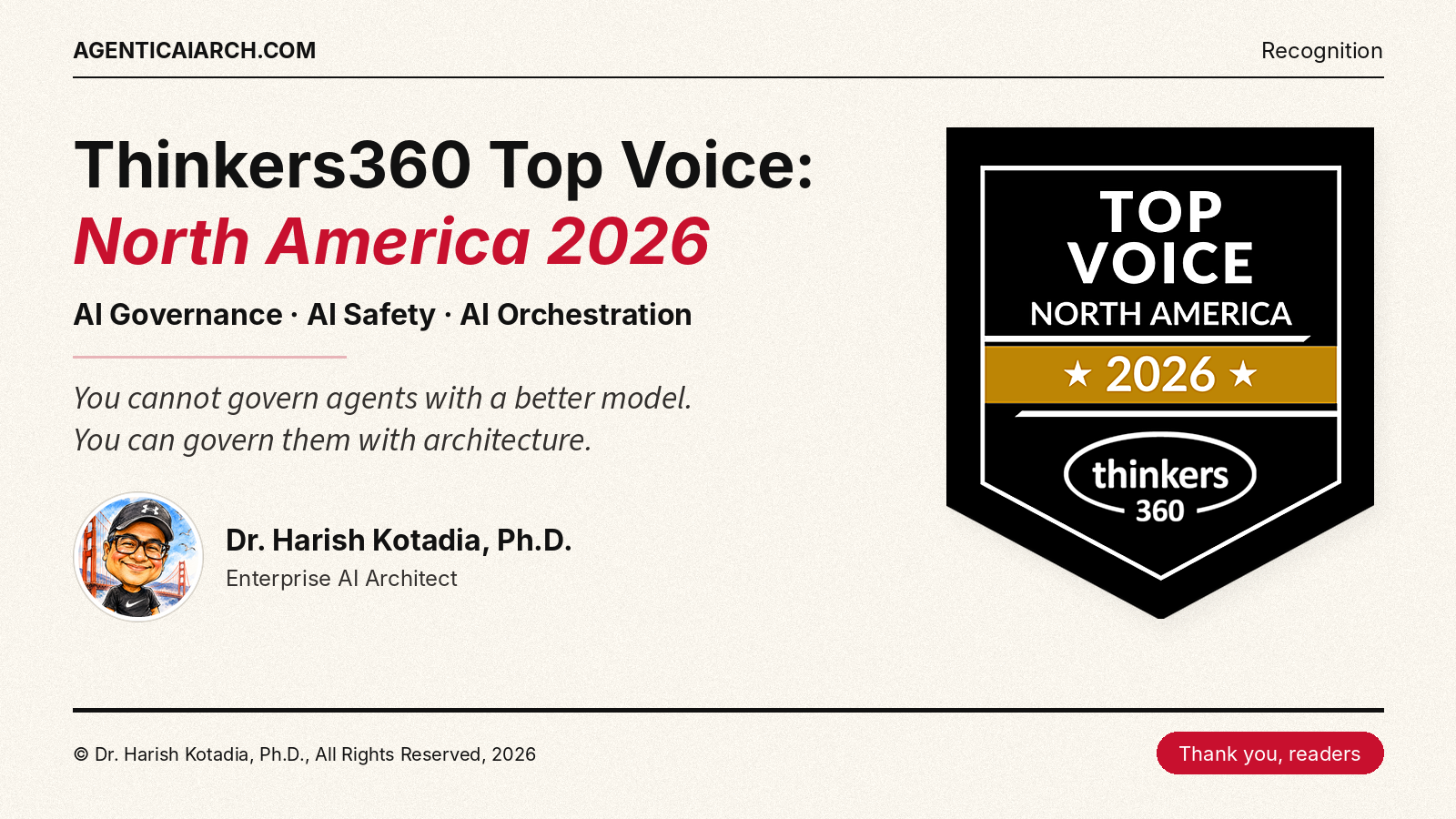
What is the Thinkers360 Top Voice award?
The Thinkers360 Top Voice award is a yearly list of experts whose writing on the Thinkers360 platform had real impact. This year’s North America list names about 50 people, and I am one of them. The award covers work published from October 1, 2025, to September 30, 2026.
New here? I publish one agentic AI governance post every weekday. Subscribe to the blog and it lands in your inbox the moment it goes live.
You cannot govern agents with a better model. You can govern them with architecture.
Who made this possible?
You did. Before anyone else, my LinkedIn connections and members made this happen. You read the posts, pushed back in the comments, and sent them to your teams. That is how a post travels, and it is how this one landed.
Then readers of agenticaiarch.com did the rest. I publish one governance post every weekday, and you kept coming back. Some of you wrote in with a hard question. Later, those questions became the next posts.
So this Thinkers360 Top Voice belongs to you as much as to me. Thank you. I mean that plainly.
What do the three leaderboards behind it say?
Each Thinkers360 Top Voice is listed with three top leaderboards. Mine, on the official North America list, are AI Governance, AI Safety and AI Orchestration. Thinkers360 ranks members by their own published work in each topic. So the list shows what I write about, not just how much.
That matters to me more than the badge, because it tracks a real shift. Not long ago, most of the AI talk I saw was about models and benchmarks. Now the questions I get are about who controls the agent once it runs. Who approved it? What can it touch? Who stops it when it is wrong?
Why is the industry shifting toward governance?
Agents now take actions instead of just giving answers. Anthropic’s study of agent autonomy in practice found that about 73 percent of tool calls had a human in the loop. In the same study, new Claude Code users ran on full auto-approve about 20 percent of the time. By 750 sessions, that share passed 40 percent. Trust grows faster than most controls do.
Here is what it looks like when the controls are missing. In 2024, a Canadian airline’s chatbot gave a grieving customer the wrong refund rule. Then the airline argued that the chatbot was responsible for its own words. But the tribunal disagreed and held the airline liable. The sum was small. The lesson was not.
That case is the whole shift in one story. Nobody asked whether the model was smart. Instead, they asked who owned the answer. That is a governance question, and only architecture can answer it.
More on Agentic AI Governance
- Ten Governance Controls: My hub post lays out ten controls in question-and-answer form.
- The Approval Gate: Here is why I gate the action, not the prompt.
- The Circuit Breaker: This post shows how to bound the impact zone before something breaks.
- The Six Layers: The pillar post maps the architecture that decides outcomes.
What changes for me now?
Being named a Thinkers360 Top Voice does not change the schedule. I will keep writing about one governance question every weekday. Each post will still lead with the risk and end with the control.
Meanwhile, my thesis has not moved. Instructions in, results out was IT. Intent in, outcomes out is agentic AI. Governance decides whether that outcome is one you can defend.
What governance question is your team stuck on right now? Tell me in the comments, and it may become a post.
Was this post useful? One click tells me what to write next.


Go deeper
- Agentic AI Architect: control design for enterprise agents.
- Agentic AI Case Studies: deployment evidence, one teardown at a time.
- Agentic AI P&L: cost, payback, and risk in a CFO’s voice.
- Agentic AI SDLC: the lifecycle that builds the agents.
- Subscribe to the Blog: I publish a new post every weekday on one agentic AI governance question. Enter your email and each post arrives in your inbox the moment it goes live.
© Dr. Harish Kotadia, Ph.D., All Rights Reserved, 2026
Dr. Harish Kotadia, Ph.D., is an Enterprise AI Architect with 20+ years of IT consulting experience serving Fortune 100 clients, specializing in agentic AI systems built on Anthropic Claude, AWS Bedrock, and Google Vertex AI.
Disclaimer: This blog post is based on publicly available academic publications, vendor documentation, open standards, and news items from reputed media sources linked above. This post is intended for educational purposes, to help the enterprise agentic AI community build a shared vocabulary from public, authoritative sources.
Views and opinions expressed here are my own and do not represent those of any employer or client, past or present. The analysis presented is my independent interpretation of the published sources linked above and does not constitute legal, financial, or consulting advice of any kind.