
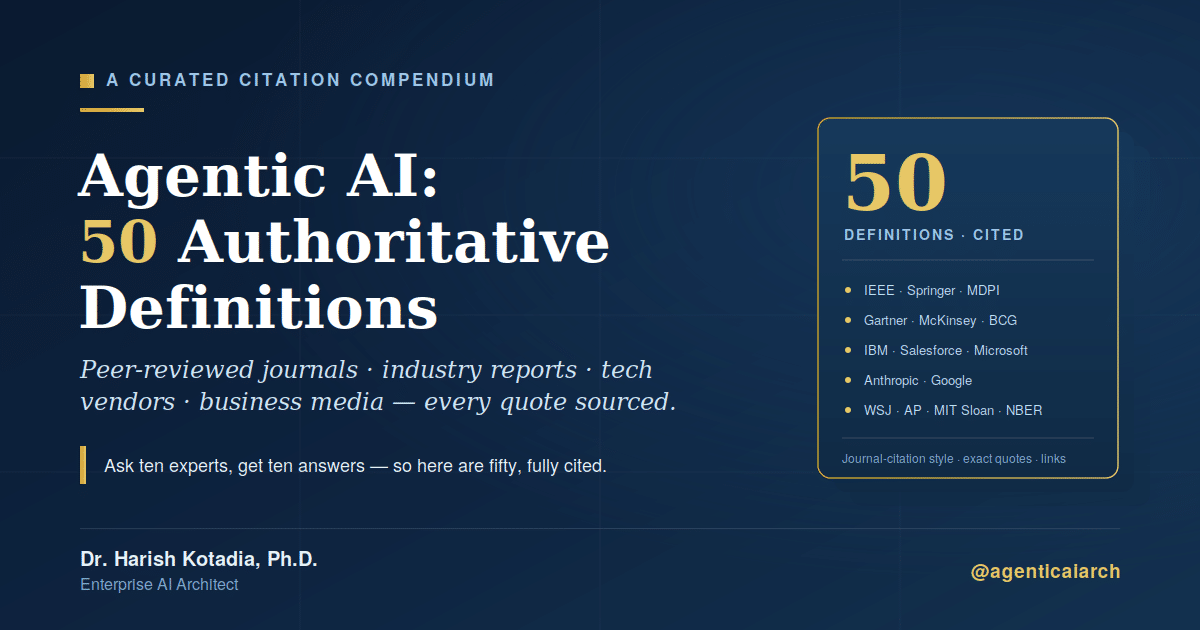
What exactly is Agentic AI? Ask ten experts and you’ll get ten answers — and that’s not a bug, it’s the most important insight in this space right now. Multiple credible sources, from MIT Sloan Management Review to Gartner, explicitly acknowledge there is no single universally agreed-upon definition.
This compendium aggregates 50 authoritative definitions drawn from peer-reviewed scholarly journals (IEEE, Springer, MDPI, F1000Research), industry research firms (Gartner, McKinsey, BCG, Deloitte), technology companies (IBM, Salesforce, Microsoft, Anthropic, Google), and major business publications. Each entry is formatted in journal-citation style with the exact source quote and hyperlink — ready to cite in your own research, presentations, or strategy documents.
Sources span: IEEE Access · Springer Artificial Intelligence Review · MDPI Future Internet · F1000Research · MIT Sloan Management Review · Gartner · McKinsey & Company · BCG · Deloitte · IBM · Salesforce · Microsoft · Anthropic · Google · UC Berkeley · MIT CSAIL · NBER · arXiv
Section I — Peer-Reviewed Journals & Academic Research
Citations 1–20 · IEEE, Springer, MDPI, F1000Research, NBER, MIT CSAIL, PMC, arXiv
● Peer-Reviewed Journal
Acharya, D.B., Kuppan, K., & Divya, B.(2025). Agentic AI: Autonomous Intelligence for Complex Goals — A Comprehensive Survey. IEEE Access.
Agentic AI, an emerging paradigm in artificial intelligence, refers to autonomous systems designed to pursue complex goals with minimal human intervention. Unlike traditional AI, which depends on structured instructions and close oversight, Agentic AI demonstrates adaptability, advanced decision-making capabilities and self-sufficiency, enabling it to operate dynamically in evolving environments.
Source: https://ieeexplore.ieee.org/document/10849561/
● Peer-Reviewed Journal
Ali, M.A., Dornaika, F., & Charafeddine, J.(2025). Agentic AI: A Comprehensive Survey of Architectures, Applications, and Future Directions. Artificial Intelligence Review, Springer Nature, Vol. 59(1).
Modern Agentic AI systems are defined by capabilities such as proactive planning, contextual memory, sophisticated tool use, and the ability to adapt their behavior based on environmental feedback. These systems operate not as mere solvers but as collaborative partners, capable of dynamical interaction with their environment.
Source: https://link.springer.com/article/10.1007/s10462-025-11422-4
● Peer-Reviewed Journal
Sapkota, R. et al.(2025). The Rise of Agentic AI: A Review of Definitions, Frameworks, Architectures, Applications, Evaluation Metrics, and Challenges. Future Internet, MDPI, Vol. 17(9), p. 404.
Traditional systems enabled the automation of individual steps that complied with limited rules; agentic AI connects these steps, tracks progress, recovers from errors, and is able to automate any end-to-end process. Agentic AI systems go beyond responding to prompts — they can observe, adapt, coordinate with other agents, and even refine their own outputs over time.
Source: https://www.mdpi.com/1999-5903/17/9/404
● Peer-Reviewed Journal
Adabara, I. et al.(2025). A Review of Agentic AI in Cybersecurity: Cognitive Autonomy, Ethical Governance, and Quantum-Resilient Defense. F1000Research. DOI: 10.12688/f1000research.169337.1.
Agentic Artificial Intelligence (AAI) refers to autonomous, adaptable, and goal-directed systems capable of proactive decision-making in dynamic environments. These agentic systems extend beyond reactive AI by leveraging cognitive architectures and reinforcement learning to enhance adaptability, resilience, and self-sufficiency.
Source: https://www.ncbi.nlm.nih.gov/pmc/articles/PMC12569510/
● Conference / Preprint
Horton, J. & Shahidi, P.(2025). AI-Mediated Transactions and the Economic Implications of AI Agents. NBER Working Paper, MIT Sloan School of Management.
Agentic AI agents are “autonomous software systems that perceive, reason, and act in digital environments to achieve goals on behalf of human principals, with capabilities for tool use, economic transactions, and strategic interaction.”
Source: https://www.nber.org/system/files/chapters/c15309/c15309.pdf
● Peer-Reviewed Journal
Wissuchek, C. & Zschech, P.(2025). Agenticness and the Spectrum of AI Agency. Referenced in Artificial Intelligence Review (Springer), Vol. 59(1).
Agenticness is defined as the degree to which a system can adaptably achieve complex goals in dynamic environments with limited direct supervision. It encompasses four key dimensions: Goal Complexity, Environmental Complexity, Adaptability, and Autonomy.
Source: https://link.springer.com/article/10.1007/s10462-025-11422-4
● Peer-Reviewed Journal
Tiwari, R.(2025). Conceptualising the Emergence of Agentic Urban AI: From Automation to Agency. Urban Informatics, Vol. 4(1). DOI: 10.1007/s44212-025-00079-7.
Agentic AI systems are characterised by autonomy, decision-making capacity, and adaptive responsiveness to dynamic digital environments. Unlike conventional AI applications, which typically operate within narrow parameters and require explicit human direction, agentic AI can engage proactively with digital platforms, autonomously performing tasks and making contextually informed decisions.
Source: https://link.springer.com/article/10.1007/s44212-025-00079-7
● Conference / Preprint
Ransbotham, S., Kiron, D., Khodabandeh, S., Iyer, S., & Das, A.(2025). The Emerging Agentic Enterprise: How Leaders Must Navigate a New Age of AI. MIT Sloan Management Review & Boston Consulting Group.
A new class of systems — agentic AI — complicates these boundaries. These systems can plan, act, and learn on their own. They are not just tools to be operated or assistants waiting for instructions. Increasingly, they behave like autonomous teammates, capable of executing multistep processes and adapting as they go.
● Conference / Preprint
Kellogg, K. et al.(2025). AI Agents in Healthcare: Automating Complex Clinical Workflows. MIT Sloan School of Management Working Paper.
AI agents enhance large language models and similar generalist AI models by enabling them to automate complex procedures. They can execute multi-step plans, use external tools, and interact with digital environments to function as powerful components within larger workflows.
Source: https://mitsloan.mit.edu/shared/ods/documents?PublicationDocumentID=10789
● Conference / Preprint
Alawi, A. et al.(2025). Visioning Human-Agentic AI Teaming: Continuity, Tension, and Future Research. arXiv:2603.04746.
Agentic systems operate as goal-directed entities that reason, plan, act, and reflect over extended horizons, exhibiting a meaningful form of agency that allows their behavior to unfold over time rather than being fully specified at the moment of deployment. What distinguishes agentic AI from traditional AI is not merely improved performance, but its open-ended agency — the capacity to select, revise, and evolve actions, representations, and even objectives.
Source: https://arxiv.org/pdf/2603.04746
● Conference / Preprint
Mathew, D.E. et al.(2025). AI Agents vs. Agentic AI: A Conceptual Taxonomy, Applications and Challenges. arXiv:2505.10468.
By late 2023, the field had advanced further into the realm of Agentic AI — complex, multi-agent systems in which specialized agents collaboratively decompose goals, communicate, and coordinate toward shared objectives. AI Agents are widely conceptualized as instantiated operational instances of artificial intelligence designed to interface with users, software ecosystems, or digital infrastructures to develop goal-directed behavior.
Source: https://arxiv.org/html/2505.10468v4
● Peer-Reviewed Journal
Boskabadi, M.R. et al.(2025). Industrial Agentic AI and Generative Modeling in Complex Systems. Current Opinion in Chemical Engineering, Vol. 48, p. 101150.
Agentic AI is emerging as a pivotal paradigm in artificial intelligence, denoting autonomous systems capable of independently pursuing complex objectives with minimal human oversight in dynamic and uncertain environments.
Source: https://www.sciencedirect.com/science/article/pii/S2211339825000236
● Peer-Reviewed Journal
Hosseini, S. & Seilani, H.(2025). The Role of Agentic AI in Shaping a Smart Future: A Systematic Review. Array, Vol. 26, p. 100399. DOI: 10.1016/j.array.2025.100399.
Agentic AI systems are defined as AI systems capable of autonomously performing actions to achieve a specified goal, without relying on pre-defined behavioral scripts. Unlike traditional AI systems, agentic AI systems are characterized by a higher degree of agenticness — determined by four key characteristics: goal complexity, environmental complexity, adaptability, and autonomy.
Source: https://www.sciencedirect.com/science/article/pii/S2590005625000694
● Peer-Reviewed Journal
Bauer, N. et al.(2025). From the Logic of Coordination to Goal-Directed Reasoning: The Agentic Turn in Artificial Intelligence. Frontiers in Artificial Intelligence (PMC12833085).
Agentic AI is a reconstitution of agency itself within computational substrates. We propose a general theory of synthetic purposiveness, where agency emerges as a distributed and self-maintaining property of artificial systems operating in open-ended environments. The concept of synthetic teleology refers to the engineered capacity of artificial systems to generate and regulate goals through ongoing self-evaluation.
Source: https://www.ncbi.nlm.nih.gov/pmc/articles/PMC12833085/
● Conference / Preprint
Kapoor, S. et al.(2024). AI Agents and the Spectrum of Agentic Behavior. arXiv (cited in multi-agent security literature).
The modern notion of an “AI agent” lacks a precise definition. Instead, it is often useful to consider a spectrum of agency, often denoted by the term “agentic.” Systems that are more agentic can operate within complex and unexpected environments, with ambiguous initial user directives and less frequent human intervention for system guidance.
Source: https://arxiv.org/pdf/2503.12188
● Conference / Preprint
Huang, Y. et al.(2024). Agentic AI for Scientific Discovery: A Survey of Progress, Challenges, and Future Directions. arXiv:2503.08979.
Agentic AI introduces a new paradigm in the AI community, highlighting the concept of embodied intelligence and showing the importance of an integrated framework for interactive agents within complex systems. This paradigm stems from the understanding that intelligence emerges from the intricate interaction between key processes such as autonomy, learning, memory, perception, planning, decision-making and action.
Source: https://arxiv.org/pdf/2503.08979
● Conference / Preprint
Bennett, K. et al.(2025). From Legacy Fortran to Portable Kokkos: An Autonomous Agentic AI Workflow. arXiv:2509.12443.
Agentic AI refers to an artificial intelligence (AI) system composed of multiple large language model (LLM) agents that operate autonomously, with minimal intervention, to accomplish complex tasks through structured decision-making, tool use, and inter-agent communication. Unlike conventional one-shot LLM prompting, agentic systems maintain state, iterate over failures, support structured outputs, and decompose problems into subgoals delegated to specialized agents.
Source: https://arxiv.org/pdf/2509.12443
● Conference / Preprint
Papageorgiou, G. et al.(2026). Mind the Gap: How the Technical Mechanisms of Agentic AI Outpace Global Legal Frameworks. arXiv:2603.27075.
An agentic AI system is an autonomous computational system that pursues defined goals by autonomously perceiving context, planning, and executing multi-step actions — through access to tools, external systems, and other agents — with minimal human intervention once objectives are set, while adapting its behaviour based on human feedback and operating within prescribed instructions and guardrails.
Source: https://arxiv.org/pdf/2603.27075
● Conference / Preprint
Weill, P., Sebastian, I., Woerner, S., & Benedict, G.(2025). Business Models in the Agentic AI Era. MIT Center for Information Systems Research (CISR), Research Briefing.
In the agentic era, AI does not merely assist — it actively participates in value creation, business model design, and competitive positioning, requiring organizations to fundamentally rethink how they structure digital partnerships and revenue streams.
Source: https://cisr.mit.edu/publication/2025_1001_BizModelsAIEra_WeillSebastianWoernerBenedict
● Peer-Reviewed Journal
Sapkota, R. et al.(2026). Position: Agentic AI System Is a Foreseeable Pathway to AGI. arXiv:2605.12966.
The term Agentic AI is formally proposed as a paradigm marked by multi-agent collaboration, dynamic task decomposition, and coordinated autonomy. From isolated to coordinated, Agentic AI moves beyond monolithic scaling to orchestrating multi-agent systems, allowing for state-of-the-art generalization without brute-force computation.
Source: https://arxiv.org/html/2605.12966
Section II — Industry Reports & Think Tanks
Citations 21–33 · MIT Sloan, Gartner, McKinsey, BCG, Deloitte, UC Berkeley
● Industry / Think Tank
Stackpole, B.(2026). Agentic AI, Explained. MIT Sloan Management, Ideas Made to Matter (Feb 18, 2026).
AI agents or agentic AI [are] a new breed of AI systems that are semi- or fully autonomous and thus able to perceive, reason, and act on their own. Different from the now familiar chatbots that field questions and solve problems, this emerging class of AI integrates with other software systems to complete tasks independently or with minimal human supervision.
Source: https://mitsloan.mit.edu/ideas-made-to-matter/agentic-ai-explained
● Industry / Think Tank
Aral, S.(2026). Agentic AI Strategy and Risk in the Enterprise. MIT Sloan / MIT Initiative on the Digital Economy.
It’s absolutely an imperative that every organization have a strategy to deploy and utilize agents in customer-facing and internal use cases. But that sort of agentic AI strategy requires an understanding and systematic assessment of risks as well as business benefits in order to deliver true business value.
Source: https://mitsloan.mit.edu/ideas-made-to-matter/agentic-ai-explained
● Industry / Think Tank
MIT Sloan Management Review & BCG.(2025). Agentic AI at Scale: Redefining Management for a Superhuman Workforce. MIT Sloan Management Review.
Although there is no agreed-upon definition, agentic AI generally refers to AI systems that are capable of pursuing goals autonomously by making decisions, taking actions, and adapting to dynamic environments without constant human oversight.
● Industry / Think Tank
Gartner, Inc.(2024). Top Strategic Technology Trends for 2025: Agentic AI. Gartner Research (October 2024).
Agentic AI will introduce a goal-driven digital workforce that autonomously makes plans and takes actions — an extension of the workforce that doesn’t need vacations or other benefits.
Source: https://www.gartner.com/en/documents/5850847
● Industry / Think Tank
Gartner, Inc. (Verma, A.)(2025). Agentic AI Definition and Enterprise Adoption. Gartner Newsroom / RCR Wireless Report.
Agentic AI refers to artificial intelligence systems that have the agency — within defined guardrails — to go beyond merely augmenting workflows to fully automating them. These systems can take user intent, access relevant data and applications, and complete tasks end-to-end.
Source: https://www.rcrwireless.com/20250627/business/agentic-ai-gartner
● Industry / Think Tank
Gartner, Inc. (O’Sullivan, D.)(2025). Gartner Predicts Agentic AI Will Autonomously Resolve 80% of Common Customer Service Issues Without Human Intervention by 2029. Gartner Newsroom Press Release (March 5, 2025).
Agentic AI introduces a new paradigm where AI systems possess the capability to act autonomously to complete tasks. AI agents will not only provide information but will also take action — such as navigating websites to cancel memberships or negotiating optimal shipping rates on behalf of business customers.
Source: https://www.gartner.com/en/newsroom/press-releases/2025-03-05-gartner-…
● Industry / Think Tank
McKinsey & Company.(2025). Seizing the Agentic AI Advantage. McKinsey Quarterly / QuantumBlack, AI by McKinsey (June 2025).
Capable of perceiving context, reasoning through complex and multistep challenges, and acting independently across digital systems, AI agents represent the next wave of artificial intelligence, with the potential to solve the “gen AI paradox” — the fact that while many companies are adopting gen AI, few are achieving significant bottom-line impact from its use.
Source: https://www.mckinsey.com/capabilities/quantumblack/our-insights/seizing-the-agentic-ai-advantage
● Industry / Think Tank
McKinsey & Company.(2025). Agentic AI Implementations in Advanced Industries. McKinsey Insights (September 2025).
What differentiates agentic AI from prior automation waves is its potential to allow organizations to fundamentally rethink the way core processes are designed, executed, and governed. Several factors are unlocking the potential of agentic AI: recent breakthroughs in large language models, APIs that enable seamless integration, and the growing availability of GPU infrastructure — enabling agentic systems to autonomously pursue goals, make decisions, and execute tasks with minimal human intervention.
● Industry / Think Tank
McKinsey & Company.(2026). State of AI Trust in 2026: Shifting to the Agentic Era. McKinsey Technology Insights (March 2026).
In the age of agentic AI, organizations can no longer concern themselves only with AI systems saying the wrong thing; they must also contend with systems doing the wrong thing — such as taking unintended actions, misusing tools, or operating beyond appropriate guardrails.
● Industry / Think Tank
BCG / BCG Henderson Institute.(2025). Leading in the Age of AI Agents: Managing the Machines That Manage Themselves. Boston Consulting Group Publications (November 2025).
Agentic AI is both software and colleague — a form of artificial intelligence that acts. Organizations that swiftly adapt their management playbook to make full use of this transformative technology will gain the edge.
Source: https://www.bcg.com/publications/2025/machines-that-manage-themselves
● Industry / Think Tank
BCG / BCG Henderson Institute.(2025). How Agentic AI is Transforming Enterprise Platforms. Boston Consulting Group Publications (October 2025).
Agentic AI is redefining how businesses operate, installing intelligent virtual assistants that can analyze data and make decisions without human intervention.
Source: https://www.bcg.com/publications/2025/how-agentic-ai-is-transforming-enterprise-platforms
● Industry / Think Tank
Deloitte Global.(2025–26). Agentic AI: Orchestrating Intelligent Operations. Deloitte Global Consulting Report.
Agentic AI digital workers don’t just perform tasks — they identify, plan, and execute them with autonomy. This is driving organizations to fundamentally rethink how they operate, deliver value, and scale.
● Industry / Think Tank
UC Berkeley Sutardja Center for Entrepreneurship & Technology.(2024). The Next “Next Big Thing”: Agentic AI’s Opportunities and Risks. UC Berkeley SCET (December 2024).
Agents will indeed transform how we’ll transact with artificial intelligence. Gartner hails agentic AI as the top technology trend for 2025, McKinsey names it the “next frontier,” and venerable IBM weighs in with “why it’s the next big thing in AI research.” Agentic AI might actually represent the next evolution of enterprise software architecture.
Source: https://scet.berkeley.edu/the-next-next-big-thing-agentic-ais-opportunities-and-risks/
Section III — Technology Company Definitions
Citations 34–40 · IBM, Salesforce, Microsoft, Anthropic, Google, Andrew Ng
● Technology Company
IBM.(2025). What is Agentic AI? IBM Think / IBM Technology Blog.
Agentic AI is an artificial intelligence system that can accomplish a specific goal with limited supervision. It consists of AI agents — machine learning models that mimic human decision-making to solve problems in real time. Unlike traditional AI models, which operate within predefined constraints and require human intervention, agentic AI exhibits autonomy, goal-driven behavior and adaptability. The term “agentic” refers to these models’ agency — their capacity to act independently and purposefully.
Source: https://www.ibm.com/think/topics/agentic-ai
● Technology Company
Salesforce.(2025). What is Agentic AI? Salesforce Agentforce / Corporate Blog.
Agentic AI is an intelligent system that can act autonomously, reason through multi-step problems, and adapt its actions in real-time to achieve a specific business goal with minimal human supervision.
Source: https://www.salesforce.com/agentforce/what-is-agentic-ai/
● Technology Company
Salesforce.(2025). Welcome to the Agentic Enterprise: With Agentforce 360. Salesforce Press Release (October 13, 2025).
The Agentic Enterprise is where AI doesn’t replace people, it elevates them. Agentforce 360 is designed to connect humans and AI agents in one trusted system — empowering every employee to achieve more, every customer-facing moment to deliver more, and every company to operate with unprecedented intelligence and speed.
Source: https://www.salesforce.com/news/press-releases/2025/10/13/agentic-enterprise-announcement/
● Technology Company
Microsoft.(2025). Single Agents to AI Teams: The Rise of Multi-Agentic Systems. Microsoft Cloud Blog (December 2025).
Microsoft defines agentic AI as the pairing of traditional software strengths — such as workflows, state, and tool use — with the adaptive reasoning capabilities of large language models. Agentic AI has moved to the front of the pack, offering the kind of autonomous decision-making that companies crave.
● Technology Company
Anthropic.(2024). Introducing the Model Context Protocol. Anthropic Blog / Model Context Protocol Specification.
Anthropic describes MCP as the “USB-C interface in the AI field” for agentic systems — a standardized protocol connecting AI agents with data sources, tools, and external systems, enabling agents to interact with digital environments without custom-built integrations for each platform.
Source: https://www.anthropic.com/news/model-context-protocol
● Technology Company
Google DeepMind / Google Cloud.(2025). Agent-to-Agent (A2A) Protocol Announcement. Google Cloud Blog / Google I/O 2025.
Google introduced the Agent-to-Agent (A2A) protocol in 2025, a proposed standard designed to enable seamless interoperability among agents across different frameworks and vendors — positioning agentic AI as a collaborative multi-agent ecosystem rather than isolated autonomous systems.
Source: https://cloud.google.com/blog/products/ai-machine-learning/google-introduces-agent2agent-protocol
● Technology Company
Ng, A.(2024). What’s Next for AI Agentic Workflows. DeepLearning.AI Blog (June 2024).
When I see an article that talks about “agentic” workflows, I’m more likely to read it, since it’s less likely to be marketing fluff and more likely to have been written by someone who understands the technology.
Source: https://idahobusinessreview.com/2025/11/19/agentic-ai-autonomous-systems-explained/
Section IV — Business Publications & Media
Citations 41–50 · Wall Street Journal, AP, MIT Sloan Management Review, McKinsey Global Survey, Gartner, BCG Press
● Business Publication
O’Brien, M. (AP Technology Writer).(2025). Agentic AI Emerges as the Next Big Leap Beyond Chatbots. Associated Press / Idaho Business Review (November 19, 2025).
“People agreed that some software appeared more like an agent, and some felt less like an agent, and there was not a perfect dividing line. Nonetheless, it seemed useful to use the word ‘agent’ to describe software or robotic entities acting autonomously in an environment, sensing the environment, reacting to it, planning, thinking.” — Prof. Milind Tambe, Harvard University.
Source: https://idahobusinessreview.com/2025/11/19/agentic-ai-autonomous-systems-explained/
● Business Publication
Huang, J. (Nvidia CEO).(2025). Enterprise Agentic AI Keynote. CES 2025 Keynote Address (January 2025).
Enterprise AI agents would create a “multi-trillion-dollar opportunity” for many industries, from medicine to software engineering. The agentic AI age has arrived, and it represents the most transformative shift in the history of computing.
Source: https://finance.yahoo.com/news/jensen-huang-declares-age-agentic-154517698.html
● Business Publication
MIT Sloan Management Review & BCG.(2025). Agentic AI Blurs Line Between Tool and Teammate. BCG Press Release / MIT Sloan Management Review (November 18, 2025).
Agentic AI — systems that can plan, act, and learn on their own — is being embraced by organizations at a speed that outpaces the adoption of traditional and generative artificial intelligence. 76% of executives now view agentic AI more as a coworker than a tool.
Source: https://www.bcg.com/press/18november2025-agentic-ai-blurs-line-tool-teammate
● Business Publication
Shahidi, P. (MIT Sloan PhD).(2025). Transaction Cost Economics of AI Agents. MIT Sloan / NBER Working Paper.
The fundamental economic promise of AI agents is that they can dramatically reduce transaction costs — the time and effort involved in searching, communicating, and contracting.
Source: https://mitsloan.mit.edu/ideas-made-to-matter/agentic-ai-explained
● Business Publication
Weill, P., Sebastian, I., & Woerner, S.(2025). How Digital Business Models Are Evolving in the Age of Agentic AI. MIT Sloan / MIT CISR (February 2026).
In the agentic model, AI agents now extract data, draft sections, generate confidence scores, and propose follow-up questions — shifting human roles to strategic oversight and enabling a potential 20–60% boost in productivity across business functions.
● Business Publication
McKinsey Global Survey.(2025). The State of AI in 2025: Agents, Innovation, and Transformation. McKinsey & Company Global Survey (November 2025).
Agentic AI has the potential to generate $450 billion to $650 billion in additional annual revenue by 2030, representing a 5 to 10 percent revenue uplift. The adoption of AI agents at scale is most advanced in the technology industry, with insurance and healthcare sectors following.
● Business Publication
Gartner, Inc.(2025). Gartner Predicts Over 40% of Agentic AI Projects Will Be Canceled by End of 2027. Gartner Newsroom (June 2025).
At least 15% of day-to-day work decisions will be made autonomously through agentic AI by 2028, up from 0% in 2024. In addition, 33% of enterprise software applications will include agentic AI by 2028, up from less than 1% in 2024.
● Business Publication
McKinsey & Company (Isenberg, R.).(2026). Agentic AI Governance for Autonomous Systems. McKinsey Quarterly (March 2026).
Agentic AI is here — and that means AI systems are starting to make decisions and take action autonomously. Eighty percent of organizations have encountered risky behavior from AI agents, underscoring that governance frameworks must move in lockstep with deployment.
Source: https://www.mckinsey.com/capabilities/risk-and-resilience/our-insights/trust-in-the-age-of-agents
● Conference / Preprint
Chan, A. et al.(2024). The 2025 AI Agent Index: Documenting Technical and Safety Features of Deployed Agentic AI Systems. MIT CSAIL / arXiv:2602.17753.
Autonomy in agentic AI is conceptualized as a spectrum from L1 (user directs and makes decisions) to L5 (agent operates with full autonomy and user observes). More autonomy is not necessarily better — agents must be evaluated along dimensions of goal complexity, environmental interaction, tool access, and persistence of state.
Source: https://arxiv.org/html/2602.17753v1
● Business Publication
Mims, C.(2024). What is Agentic AI, and Why Should You Care? The Wall Street Journal (May 10, 2024) — cited in UC Berkeley SCET Review.
Agentic AI goes beyond chatbots by taking autonomous actions. Unlike generative AI, which responds to prompts by producing text or media, agentic AI perceives its environment, sets subgoals, and executes sequences of actions toward a larger objective — with or without human checkpoints along the way.
Source: https://scet.berkeley.edu/the-next-next-big-thing-agentic-ais-opportunities-and-risks/
8 Definitional Themes Observed Across All 50 Sources
- Autonomy: All sources agree agentic AI operates with minimal or no continuous human supervision.
- Goal-Directedness: Systems pursue defined objectives rather than responding to isolated prompts.
- Multi-Step Reasoning: Agentic systems plan, decompose, and execute across sequences of actions.
- Tool Use & Environment Interaction: API calls, web access, code execution, file manipulation.
- Adaptability: Systems respond to feedback, environmental changes, and failure states.
- Multi-Agent Coordination: Advanced agentic systems involve orchestrated fleets of specialized agents.
- Economic Agency: Emerging literature (MIT/NBER) extends the definition to include financial transactions and strategic negotiation.
- No Universal Definition: MIT SMR, Gartner, and multiple academic sources explicitly note the absence of a single agreed-upon definition as of 2025–26.
About the Author
Dr. Harish Kotadia, Ph.D. is an Enterprise AI Architect with 20+ years of IT consulting experience specializing in Agentic AI systems built on Anthropic Claude, AWS Bedrock, and Google Vertex AI.
Follow his thought leadership at AgenticAIArch.com and @agenticaiarch on X/Twitter and LinkedIn
© Harish Kotadia, 2026. All Rights Reserved.