
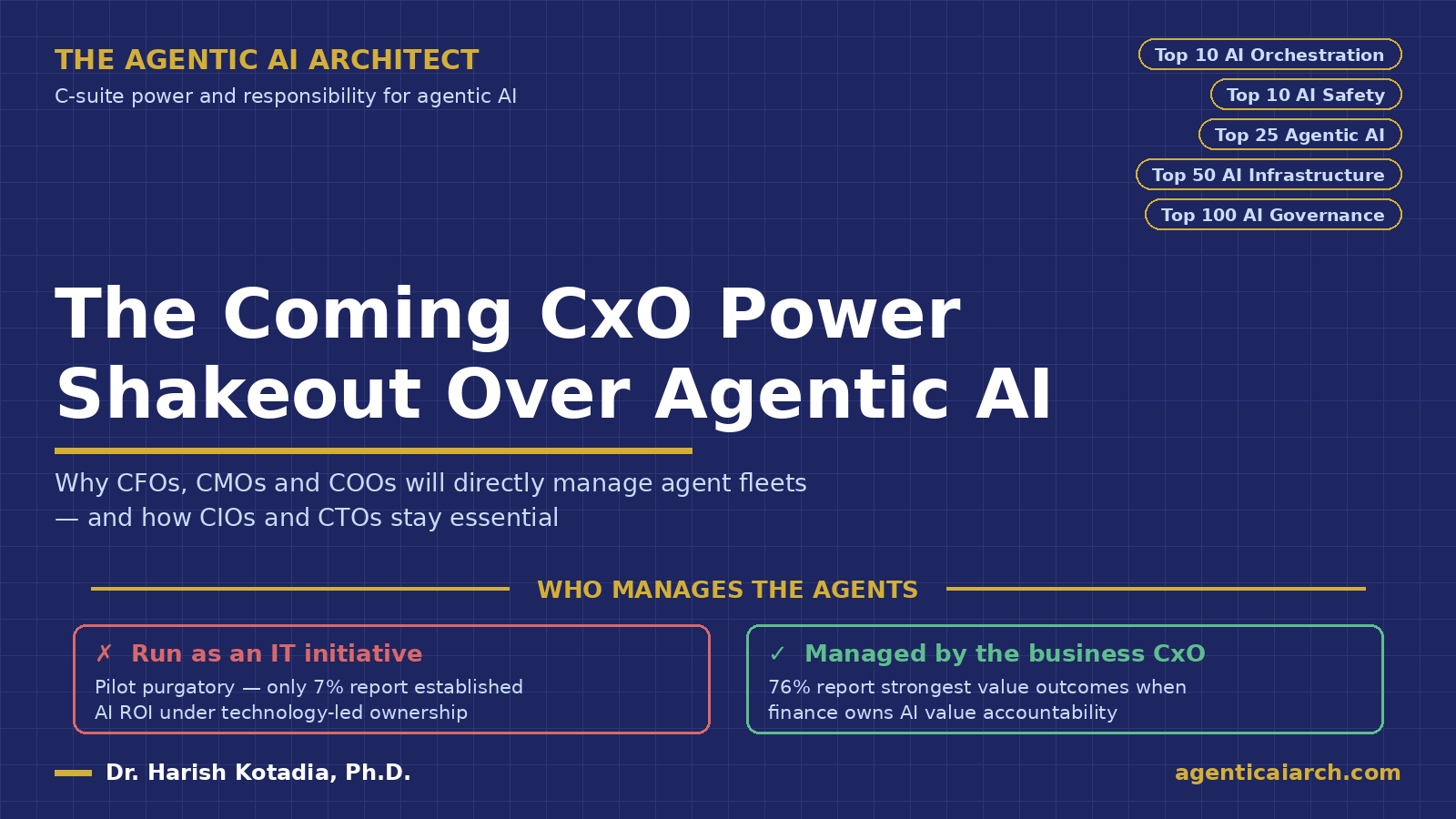
A power shakeout is coming in the C-suite over agentic AI: within the next two to three years, CFOs, CMOs, and COOs will move from funding agentic AI deployments to directly managing them, and CIOs and CTOs who keep treating these programs as technology initiatives will find themselves running the plumbing while someone else runs the program. I have watched this exact transfer of power happen twice before — in the social media revolution and again in the big data revolution — and the early data says it is happening again, on a much larger scale.
I have been in technology consulting long enough to have lived through several of these waves from the inside: ERP and CRM in the Siebel and PeopleSoft era, the social media revolution and Social CRM, the big data revolution, cloud and DevOps, and now AI and agentic AI. Each wave followed the same arc. Technology leadership owns the early phase because the work looks technical. Then the technology starts touching revenue, customers, or cost directly — and the business CxO whose P&L it touches stops asking for status updates and starts running the deployment. The CIO does not lose the argument. The CIO loses the org chart.
I Watched the CMO Take Social. Then I Watched the Business Take Big Data.
The first time I saw this transfer happen was during the Social CRM years, roughly 2010 to 2016, when I was publishing on the subject constantly. Social media entered the enterprise through IT and corporate communications. It did not stay there. Within a few years the CMO owned the platforms, the budgets, the agencies, and the vendor relationships — because social touched customers, and customers belonged to marketing. Gartner made the era’s most famous prediction back in 2012: that CMOs would spend more on technology than CIOs by 2017. Directionally, that is exactly what happened. Marketing clouds, social listening platforms, and customer engagement tools were bought, deployed, and managed by marketing organizations, with IT reduced to integration support.
The second time, I was even closer to it. I led big data practice work during the years when Hadoop clusters were multiplying, and I watched the same pattern repeat at higher stakes. Big data started as an infrastructure conversation — clusters, ingestion, data lakes. It ended as a business conversation. CFOs sponsored fraud analytics directly. COOs ran supply chain optimization programs with their own data science hires. CMOs built customer analytics teams that reported to marketing, not IT. The Chief Data Officer role was invented in this period largely because business CxOs demanded a data leader who answered to business outcomes rather than to infrastructure uptime. The projects that succeeded were the ones a business executive personally managed. The ones that stalled were the ones IT ran as “big data initiatives” hunting for a use case.
Two waves, one lesson: when a technology’s output is a business outcome, the business executive who owns that outcome ends up managing the deployment. Not sponsoring it. Managing it.
Why Agentic AI Repeats This Pattern at Ten Times the Scale
Agentic AI does not just touch business outcomes the way social and big data did. It produces them. Agentic AI is intent in, outcomes out — an agent closes the reconciliation, resolves the claim, processes the loan application, executes the campaign step. Social media gave the CMO a new channel. Big data gave the CFO better analysis. Agentic AI gives every business CxO a workforce. That is a categorically bigger claim on ownership, and it is why I believe this power transfer will dwarf the previous two.
There is a second accelerant the earlier waves did not have: consumption pricing. An agent fleet bills by the token, continuously, and lands on the P&L every month. In my recent post on what ails agentic AI FinOps, I flagged a number from the State of FinOps 2026 report that stopped me cold: 78% of FinOps practices report to the CTO or CIO, and only 8% to the CFO. The people who grant an agent autonomy and the people who cap what it may spend sit in the same reporting line. No CFO tolerates that arrangement forever. Spend limits on autonomous systems are a financial control, and financial controls migrate to finance. Every time.
The Shift Is Already in the Survey Data
This is not a forecast I am making on pattern recognition alone. The 2026 numbers already show technology leadership’s grip loosening:
Purchasing authority has fragmented away from the CIO. Futurum’s 1H 2026 Platforms Decision Maker Survey of 838 organizations put primary AI purchasing authority with the CIO at just 13% — behind the CTO at 25% and barely ahead of the CEO at 12%, with the rest scattered across CAIOs, CDOs, CISOs, and CFOs. Account control through the CIO relationship, the model that defined enterprise IT selling for three decades, is dissolving.
CEOs and CFOs are claiming the decision. BCG’s AI Radar 2026, drawing on 2,360 executives, found 72% of CEOs calling themselves the main AI decision-maker — double the prior year. Bain’s 2026 CFO survey found 83% of CFOs planning to raise AI budgets by more than 15% over two years. A CFO raising a budget that fast does not intend to hand it to another function and hope.
And the ROI evidence favors business ownership decisively. A Harvard Business Review and Return on AI Institute survey of 1,006 executives found that only 2% of companies place AI value accountability with the CFO — but where they do, 76% report the strongest value outcomes, against 53% under the CIO or CTO. Meanwhile KPMG’s Q2 2026 Global AI Pulse, covering 2,145 senior leaders, found just 7% reporting established AI ROI. Sit with that pairing. Under technology-led ownership, the ROI record is dismal; under finance-led accountability, value capture jumps by more than twenty points. Boards read these surveys too.
Where CIOs and CTOs Will Come Up Short
I want to be precise here, because I am not arguing that technology leaders are failing at technology. They are failing at framing. The default CIO/CTO playbook treats agentic AI as an infrastructure program: platform selection, model evaluation, integration architecture, a center of excellence. All necessary. None of it answers the only question the rest of the C-suite is asking, which is what one completed task costs and what business outcome it produced. In my library of enterprise agentic AI case studies — 315 public cases and counting — the deployments that reached production value almost always had a business-side owner accountable for the outcome. The ones that stalled in pilot purgatory were, overwhelmingly, technology-led initiatives searching for a sponsor after the fact.
There is also a structural conflict technology leaders cannot resolve from inside their own function. When the CIO’s organization both grants agent autonomy and monitors agent spend, there is no separation of duties — and in a regulated enterprise, that is not a style preference, it is a control defect an auditor will eventually write up. The CFO will not need to fight for a seat at the autonomy gate. Audit will pull up the chair.
What CFOs, CMOs, and COOs Will Actually Do
Direct management, not enhanced sponsorship. Expect CFOs to run finance agent fleets — reconciliation, close, collections — with their own agent operations leads, holding model tier limits and per-agent spend caps as finance-owned controls. Expect COOs to own claims, fulfillment, and service agents the way they own the human teams doing that work today, because an agent workforce is an operations asset, not an IT asset. Expect CMOs to run campaign and customer engagement agents under marketing’s roof, exactly as they absorbed the marketing cloud a decade ago. The business CxO will set the intent, own the outcome metric, and manage the deployment. In my work in regulated loan origination, I have already seen the pattern forming: the executives asking the sharpest questions about agent autonomy levels are not the technologists. They are the credit risk and operations leaders whose portfolios the agents touch.
The Collaborative Model: How Technology Leaders Stay Essential
Here is my honest advice to CIOs and CTOs, and it starts with an admission: fighting this shift is how you lose everything. The CIOs who fought the CMO over social lost social and credibility. The winning move is to stop running agentic AI as a technology initiative and start running it as a jointly governed business program. Concretely:
- Give every agent deployment a business CxO owner on day one. No agent enters production without a named business executive accountable for its outcome metric and its cost per completed task. If no business leader will own it, that is your signal the deployment should not exist.
- Reposition your organization as the governance and assurance provider. Own the platform, the agent identity layer, the execution boundaries, the observability — the controls every business-owned fleet must run on. That role grows as agent fleets multiply. The application-ownership role shrinks.
- Adopt cost per completed task as the shared language. Tokens and GPU hours are your dialect, not the CFO’s. Translate every deployment into cost per outcome and you become the executive who makes agent economics legible — which is a seat at the table no one revokes.
- Put finance at the autonomy gate voluntarily, before audit puts them there. Expanding an agent’s scope is a change with financial exposure; treat it with change control and separation of duties. Offering this control structure proactively builds the CFO alliance. Having it imposed destroys it.
- Stand up a joint autonomy review board. CIO, CFO, and the owning business CxO, scoring every deployment’s readiness before its autonomy expands. My Five-Stage Agentic AI Roadmap — Prompted, Piloted, Governed, Assured, Autonomous — gives that board its ladder, and the scoring methodology I published in Earned Autonomy gives it the instrument.
I built the EAI-1000 Earned Autonomy Index from 507 enterprise agentic AI deployments, and one finding from that dataset belongs in this argument: not a single case has yet earned the Autonomous stage, and Outcome Assurance is the pillar that caps just over half of them. Outcome assurance is a business judgment. Technology leaders cannot certify business outcomes alone — which is the deepest reason the business CxO ends up inside the deployment, not above it. The practitioner’s field guide for running programs this way is in Intent In, Outcomes Out.
The Question to Ask Before Your Next Steering Committee
ERP made the CIO powerful. Social made the CMO a technology buyer. Big data made every business CxO a project owner. Agentic AI will make business executives direct managers of digital workforces — and the technology leaders who thrive will be the ones who architected the governance that made that safe, not the ones who insisted the agents belonged to IT.
So ask one question at your next agentic AI steering committee: for each agent in production, which business executive manages it — not sponsors it, manages it? If every answer points back to the CIO’s organization, the shakeout has not reached you yet. It will.
Related reading on my site: definition of agentic AI, five-stage agentic AI roadmap, what ails agentic AI FinOps, and my library of enterprise agentic AI case studies. My governance methodology in full is in Earned Autonomy, available on Kindle.
© Dr. Harish Kotadia, Ph.D., All Rights Reserved, 2026.
Dr. Harish Kotadia, Ph.D., is an Enterprise AI Architect with 20+ years of IT consulting experience serving Fortune 100 clients, specializing in agentic AI systems for regulated enterprise environments, including loan origination.
Disclaimer: This blog post is based on recent survey findings and news items drawn from reputed media and analyst sources available in the public domain and cited above. This post is intended for educational purposes, to help the enterprise agentic AI community learn from public information on the governance and organizational management of agentic AI in large enterprises.
Views and opinions expressed here are my own and do not represent those of any employer or client, past or present. The analysis presented is my independent interpretation of the published reports cited above and does not constitute legal, financial, or consulting advice of any kind.