
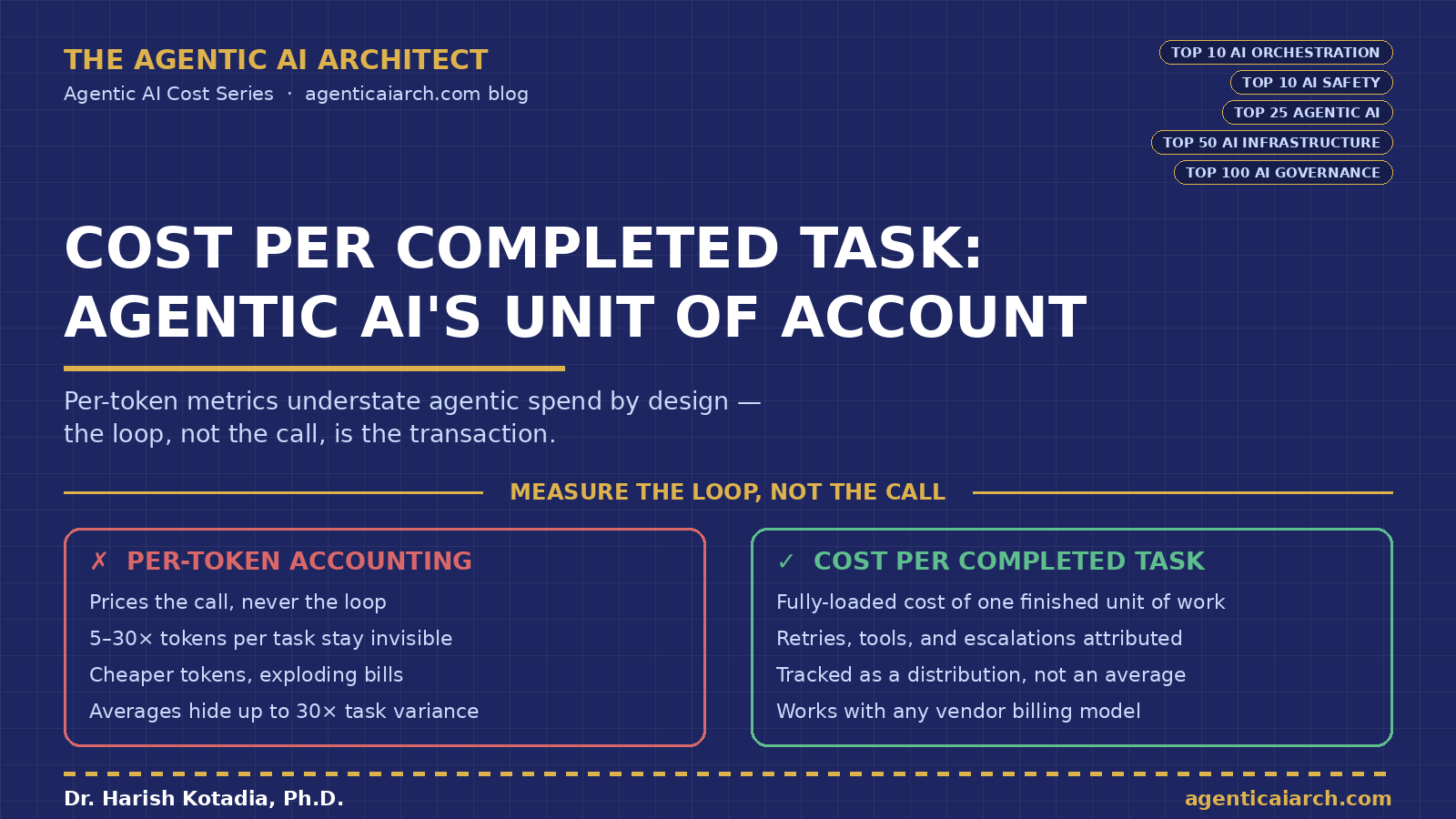
Cost per completed task is the total spend an agentic AI system incurs to finish one unit of work — every token, tool call, retry, escalation, and minute of human review, added up across the whole loop. Not the price of one model call. The whole loop. This is the thesis I laid out on this site in For Agentic AI, Compute Is Not a Fixed Line Item, where I defined per-decision cost as the unit IT budgeting has never had — and it’s the argument running through my book Intent In, Outcomes Out and my Agentic AI P&L newsletter, where I put it bluntly: per-token and per-call metrics understate agentic spend by design, because the loop, not the call, is the transaction.
What’s striking is who else has arrived at the same conclusion. McKinsey, Gartner, the FinOps community, and academic researchers at Princeton and Stanford have all converged, independently, on task-level cost as the metric that matters. When I went digging through the literature to pressure-test my own thesis, I found it wasn’t a lonely position — it’s where the whole field is settling. Here’s the evidence.
Why per-token metrics understate agentic spend
An agentic AI task is never one call. It plans, calls tools, reads the results, re-reads its own context, retries, and refines — and every step burns tokens the sticker price never showed you. The multipliers are now well documented:
| Source | Finding |
|---|---|
| Gartner, 2026 | Agentic models need 5–30× more tokens per task than a standard GenAI chatbot; reasoning agents up to 150× on a single task |
| Anthropic engineering, 2025 | Multi-agent systems use roughly 15× the tokens of a chat; even single agents run about 4× |
| McKinsey / Stanford Digital Economy Lab | Long-context coding agents can hit ~1,000× versus simple code chat — driven by input tokens re-read, not output generated |
| EY, 2026 | A simple linear workflow cost ~$0.04 per interaction in 2023; a modern agentic orchestration runs ~$1.20 — about 30× — even as per-token prices fell |
That last line is the one CFOs should sit with. Per-token compute costs are falling — Goldman Sachs pegs the decline at 60–70% a year — and total agentic spend is rising anyway. Gartner calls this the Inference Paradox and forecasts inference cost per agentic workflow rising more than fivefold through 2028. Cheaper tokens will not save a budget when each task consumes multiples more of them. If your dashboard shows cost per call trending down, that is not evidence your agentic program is getting cheaper. It might be evidence you’re measuring the wrong thing.
Three fields converged on the same metric
The strongest sign a metric is right is when people who don’t read each other arrive at it independently. That’s what happened here.
Academia got there first. Princeton’s “AI Agents That Matter” (2024) argued agent benchmarks must report dollar cost alongside accuracy and plot the two as a Pareto frontier — on one coding benchmark, agents at similar accuracy differed in cost by nearly two orders of magnitude. Stanford’s “Cost-of-Pass” (2025) went further and formalized the unit: expected cost of an attempt divided by the probability of a correct answer. Cost per correct task, as a formula.
Consulting caught up in 2026. McKinsey’s QuantumBlack interview with Pay-i’s CEO put it flatly: “The metric that matters is cost per completed task” — and noted that number has risen steadily in every workload they see. On the FinOps side, TechTarget’s practitioner guidance lands on “cost per completed business outcome” — a resolved support case, a merged code change, a finished procurement step. The FinOps Foundation’s State of FinOps 2026 found 98% of practitioners now manage AI spend, up from 31% two years ago. The discipline is forming around exactly this unit.
And vendors are already billing this way. Intercom’s Fin charges $0.99 per resolution. Sierra charges per successful outcome. Salesforce’s Agentforce has cycled through per-conversation, per-action, and per-user pricing in under two years, which tells you how hard — and how consequential — the unit choice is. When academia, McKinsey, and actual price lists triangulate on the same unit, that’s not a trend piece. That’s the market settling.
Define the task, or the metric collapses
The metric’s biggest weakness isn’t conceptual. It’s definitional. BCG found that jobs-completed pricing is among the least adopted models for one reason: vendors and customers can’t agree on what a completed job is. Intercom counts an “assumed resolution” when a customer simply exits the chat — which, if I’m honest, sometimes means the customer gave up. In my work in regulated loan origination, a “completed” credit decision that later fails an audit wasn’t completed at all.
So before measuring, write down three things:
- The completion criterion. What observable event marks the task done — and done correctly? For origination, that’s a decision that survives compliance review, not a decision rendered.
- Escalation handling. If the agent hands off to a human, does the task count, and does the human’s time count toward its cost? (It should.)
- Failed attempts. Retries and abandoned runs get attributed to the cost of the tasks that eventually completed. The fully-loaded cost of a resolved task includes the wreckage of the unresolved ones.
Skip this step and the metric becomes theater — a number everyone reports and nobody trusts.
Instrument the fully-loaded cost, and track it as a distribution
Once the unit is defined, capture everything the loop consumes per task trace: input, output and reasoning tokens, tool and API calls, retries, orchestration overhead, infrastructure, and human review time. That mirrors what the FinOps FOCUS billing standard is normalizing and what McKinsey’s six cost drivers enumerate — where roughly 60% of an agentic task’s cost sits in refining answers, not producing the first draft.
One more thing, and it matters: track cost per completed task as a distribution, not an average. The same task can vary in cost by up to 30× depending on how the loop unfolds. A mean hides the tail, and in agentic systems the tail is where budgets die.
When a simpler proxy is fine
I’ll concede the boundary conditions. If frontier token prices ever fall faster than tokens-per-task rise (Gartner says the opposite through 2028), or if agentic multipliers compress toward chatbot levels, or if your AI spend is simply too small for task-level attribution to pay for itself — a per-conversation proxy will do. McKinsey’s interview cites roughly $3M a year with a single provider as the point where serious capacity planning kicks in. Below that, track lightly. Above it, the loop is the transaction, and your accounting should say so.
I’ve been making this argument across my per-decision cost post, my books, and my newsletters, and I maintain a library of 507 verified enterprise agentic AI deployments — browse them in my case study Rolodex. The pattern across the successful ones is consistent: they knew what a completed task cost before they scaled. The failures found out after. That so many independent voices — McKinsey, Gartner, the FinOps Foundation, Princeton, Stanford — are now saying the same thing tells me this isn’t a hot take anymore. It’s the accounting standard forming in real time.
What unit of account is your agentic AI program using today? I’d like to know, so leave a comment:
Related reading on my site: definition of agentic AI, five-stage agentic AI roadmap, and library of enterprise agentic AI case studies. My governance methodology in full is in Earned Autonomy, available on Kindle.
© Dr. Harish Kotadia, Ph.D., All Rights Reserved, 2026.
Dr. Harish Kotadia, Ph.D., is an Enterprise AI Architect with 20+ years of IT consulting experience serving Fortune 100 clients, specializing in agentic AI systems built on Anthropic Claude, AWS Bedrock, and Google Vertex AI.
Disclaimer: This blog post is based on recent events and news items drawn from reputed media sources and vendor websites available in the public domain and quoted above. This post is intended for educational purposes, to help the enterprise agentic AI community learn from public information on the application and use of agentic AI tools and technology in Fortune 500 companies.
Views and opinions expressed here are my own and do not represent those of any employer or client, past or present. The analysis presented is my independent interpretation of published news reports quoted above and does not constitute legal, financial, or consulting advice of any kind.