
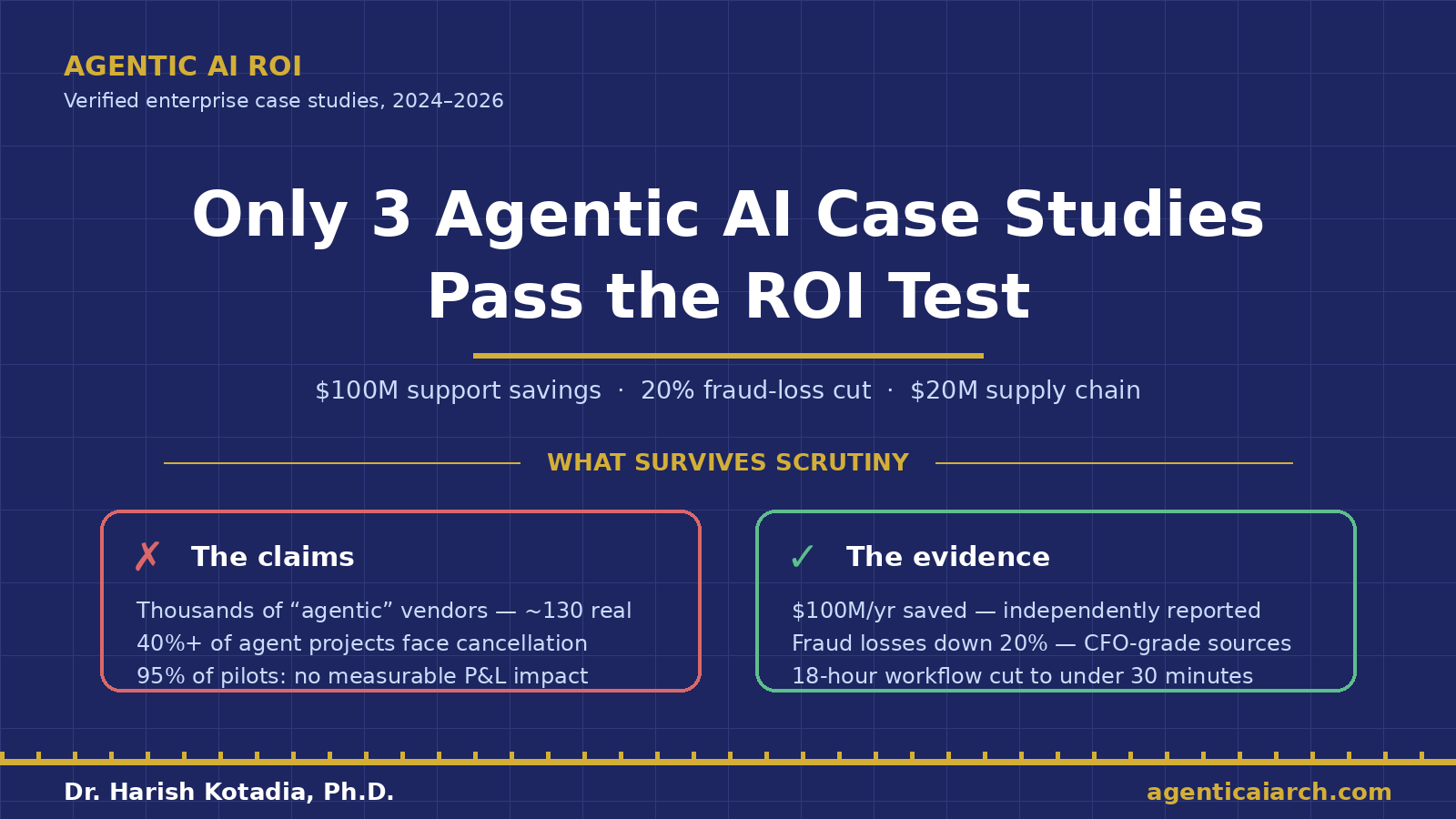
The best documented ROI in enterprise agentic AI today comes from three production deployments: an enterprise software provider saving $100 million a year on support, a retail bank that cut fraud losses more than 20% with an agent that writes its own detection rules, and a packaged-food manufacturer that took $20 million out of its supply chain.
Most agentic AI ROI claims don’t survive scrutiny
Gartner predicted in mid-2025 that over 40% of agentic AI projects will be canceled by the end of 2027. Same research house estimated that of the thousands of vendors calling themselves “agentic,” only about 130 are building real agents. MIT’s 2025 State of AI in Business work found roughly 5% of enterprise AI pilots extracting real value. The other 95% show no measurable P&L impact. Sit with that number for a second.
So I applied a hard filter. To make my list, a case had to clear four bars:
- Genuine agentic behavior — the system plans, uses tools, takes multi-step actions, and escalates exceptions. Not a Q&A chatbot.
- Hard, quantified outcomes — dollars, loss percentages, or cycle time with financial impact. Not “productivity gains.”
- A named executive or an independent business journal standing behind the number. Vendor case studies alone don’t count.
- Production scale, not a pilot.
Three cases cleared all four:
Case 1: A global software provider saving $100 million a year on support
A global enterprise software provider put an autonomous support agent on its own self-service portal, grounded in more than 740,000 knowledge articles plus account and entitlement data. First year: 3 million conversations across seven languages, escalating to a human inside the same chat window with an auto-summarized handoff when judgment or urgency demanded it. A second agent works dormant inbound leads on its own — outreach, qualification, routing to human sellers.
The results were independently reported by Fortune in April 2026: $100 million in annualized cost savings, support caseload down 8% year over year — more than 170,000 fewer cases against a growing customer base — and over 3,200 sales opportunities influenced by the lead agent.
Forget the $100 million for a moment. The number I trust is the 8% caseload drop while customers grew. You can’t spin that metric; it either happened or it didn’t. The company’s president of customer success told Fortune that “AI agents can scale our cost structure infinitely” — then added that the real unlock is scaling capacity. Most cost-cutting deployments never get to that second half.
Case 2: A retail bank cutting fraud losses 20% in a regulated environment
A major retail bank built, entirely in-house, an agent that spots novel fraud patterns in payments data and drafts new detection rules to intercept them. A human approves every rule before it goes live. The system runs on a cloud data platform wired into the bank’s core banking stack, screening more than 80 million signals a day across 20-plus million daily payments.
Per the bank’s fraud chief and its published AI disclosure: fraud losses down more than 20% in the first half of fiscal 2026 versus the prior year, customer scam losses down 76% from their peak, and the agent has now contributed to three-quarters of the bank’s card-fraud rules.
This is the case I keep coming back to. Look at what the agent is allowed to do and what it isn’t. It proposes rules. Humans approve them. The bank’s disclosure commits to “clear human accountability for outcomes.” People read that as a brake on ROI. I’d argue it’s the source of it. In my work in regulated loan origination, the deployments that survive audit are the ones where the autonomy boundary got drawn before the first agent ran — not after the first incident.
Case 3: A food manufacturer taking $20 million out of its supply chain
A Fortune 500 packaged-food manufacturer, working with a commercial data-platform partner, built an agentic logistics program that assesses more than 5,000 daily shipments and optimizes orders into truckloads on its own. Underneath it sits a data governance regime holding ERP master data at roughly 97% accuracy. Years of unglamorous work, done before any agent showed up. That’s not a footnote — that’s the deployment.
The CFO put the figure on record at an investor conference: more than $20 million in savings since fiscal 2024. Order-to-truckload optimization that used to take 18 hours now runs in under 30 minutes, per the chief supply chain officer, and the program has taken 15,000 tons of carbon off the road through fewer trucks. Reported from the company’s investor remarks.
A food company. Not a bank, not a software vendor. Which is exactly why it belongs in the top three — the pattern travels. And a CFO stating a dollar figure to investors clears a bar no vendor case study ever will.
What the three winners have in common
Every one of these is a narrow, high-volume, rules-bound workflow with a clean feedback loop and a human escalation lane designed in on day one. Nobody handed an agent open-ended autonomy and hoped.
That matches what I found scoring 507 enterprise deployments for the EAI-1000 framework in Earned Autonomy. Outcome assurance — proving the agent’s work, not just producing it — is the binding constraint in over half of all cases, and not one deployment I scored has earned fully autonomous operation.
Related reading on my site: definition of agentic AI, five-stage agentic AI roadmap, and library of enterprise agentic AI case studies. My governance methodology in full is in Earned Autonomy, available on Kindle.
© Dr. Harish Kotadia, Ph.D., All Rights Reserved, 2026.
Dr. Harish Kotadia, Ph.D., is an Enterprise AI Architect with 20+ years of IT consulting experience serving Fortune 100 clients, specializing in agentic AI systems built on Anthropic Claude, AWS Bedrock, and Google Vertex AI.
Disclaimer: This blog post is based on recent events and news items drawn from reputed media sources and vendor websites available in the public domain and quoted above. This post is intended for educational purposes, to help the enterprise agentic AI community learn from public information on the application and use of agentic AI tools and technology in Fortune 500 companies.
Views and opinions expressed here are my own and do not represent those of any employer or client, past or present. The analysis presented is my independent interpretation of published news reports quoted above and does not constitute legal, financial, or consulting advice of any kind.