
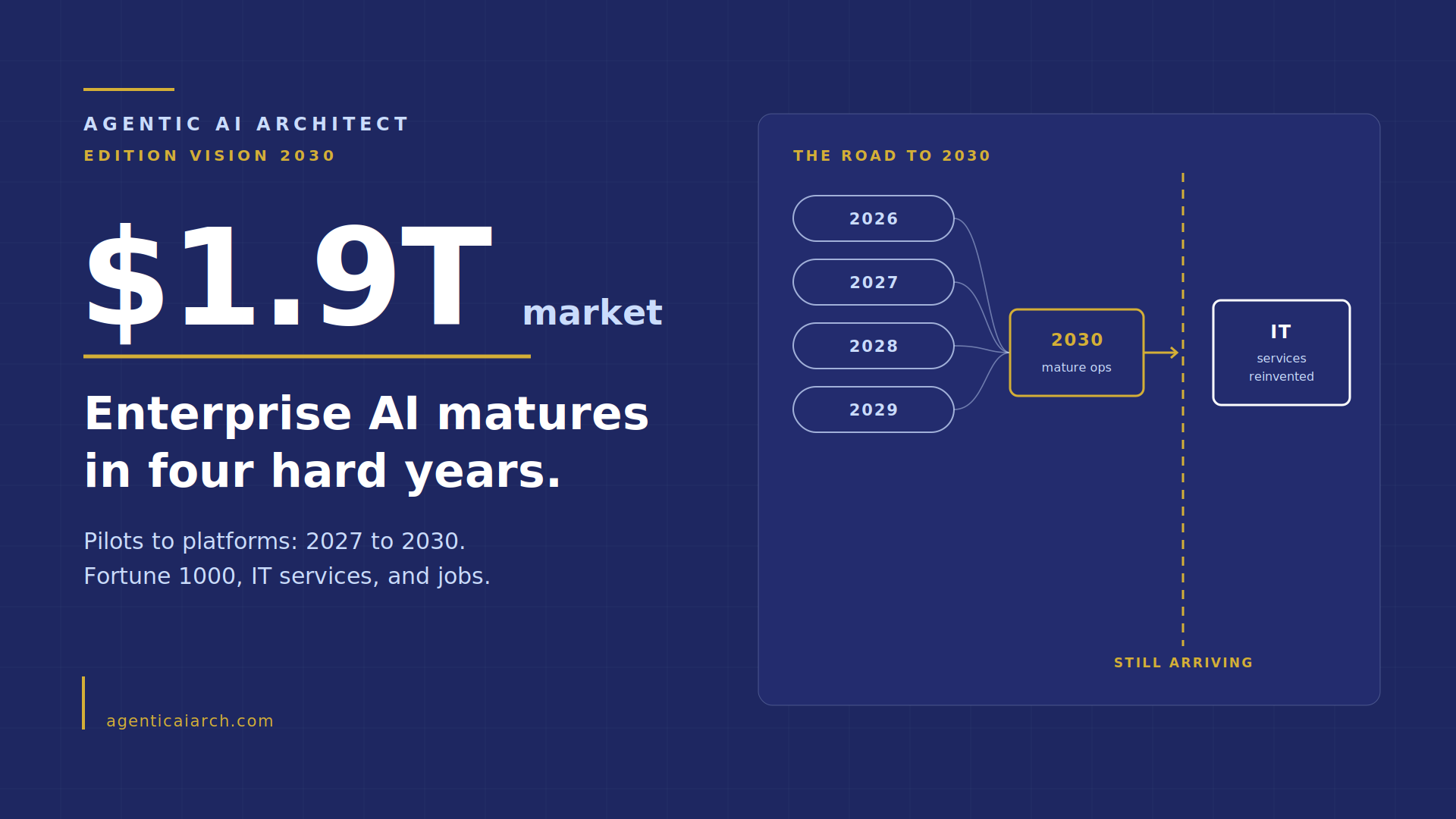
Enterprise agentic AI is not arriving in a straight line. It’s a J-curve: a rough two years of pilots and cancellations, then a scramble to scale, then — if the forecasts hold — an operating model that looks nothing like the IT services industry of 2025. Most analysts, academics and IT services leaders agree on that shape. They disagree, often loudly, on how fast it moves and how far it actually gets.
What follows draws on Gartner, McKinsey, Deloitte, the World Economic Forum, a handful of academic labor economists who are considerably less bullish than any consulting firm, and public statements from the IT services companies themselves. Put together, it maps where enterprise agentic AI is headed through the end of the decade, and what that means for the people who actually build and run enterprise technology.
2026–2027: The Shake-Out Year
Most agentic AI activity today is still experimental, whatever the vendor decks say. McKinsey’s State of AI research found 88% of organizations use AI in at least one function. Far fewer — about a third — have actually begun scaling anything, and within any given function, no more than roughly 10% report scaling agents at all.
That gap is about to get expensive. Gartner’s analyst said this plainly: “most agentic AI projects right now are early stage experiments or proof of concepts that are mostly driven by hype and are often misapplied.” Gartner forecasts more than 40% of agentic AI projects will be cancelled by the end of 2027 — killed by escalating costs, unclear business value, and risk controls that never quite got built. And yet, in the same breath, Gartner expects task-specific agents in 40% of enterprise applications by the end of 2026 (up from under 5% a year earlier), with agentic AI spending overtaking chatbot and assistant spending for the first time in 2027. Both things are true. That’s the shake-out.
Call it a bifurcation point. Deloitte expects the full switch from generative to agentic AI to play out in 2027, with half of GenAI-using enterprises launching agentic pilots. The organizations that come out ahead share a pattern: workflow-integrated deployments with clear KPIs, real data readiness, and governance built in from day one — not agents bolted onto whatever process already existed.
2028: Scaling Becomes Real
By 2028, Gartner projects at least 15% of day-to-day work decisions will be made autonomously through agentic AI — up from effectively zero in 2024 — with agentic capability built into a third of enterprise software. Multi-agent ecosystems, networks of specialized agents collaborating across applications, stop being a diagram in a slide deck and start being how work actually gets routed.
Governance can’t keep up. Deloitte found only about 21% of organizations had a mature governance model for agentic AI even as deployment accelerated past them. That gap — not the technology itself — is probably what separates the organizations that pull ahead from the ones stuck paying for AI sprawl they can no longer see the edges of.
2029: The Digital Workforce Arrives
Gartner’s most recent AI spending forecast is the first to break out agentic AI as its own category, and the number is striking: $752.7 billion by 2029, growing at a 119% compound annual rate, overtaking chatbot spending as early as 2027. Total AI spending across the enterprise is projected to hit $4.7 trillion by then. IDC expects roughly 30% of IT services contracts to be outcome-based by this point, with a similar share delivered as modular, platform-enabled products rather than billable hours.
This is the year “digital workforce” stops being conference-keynote language and starts being how leading Fortune 1000 organizations genuinely describe their own operating model.
2030 and Beyond: An Agentic-Native Operating Model
McKinsey Global Institute puts a number on the ceiling: in a midpoint adoption scenario, AI-powered agents and robots could technically automate around 57% of U.S. work hours by 2030 (44% through agents, 13% through robots), generating roughly $2.9 trillion in annual U.S. economic value. Worth underlining — that’s a technical-potential estimate, not a jobs forecast, and the gap between “technically possible” and “actually happens” is where most of this story lives. Separately, McKinsey expects the broader technology services market to grow to $1.6–1.9 trillion by 2030, on the theory that new agentic value pools more than offset a projected 20–30% compression of the traditional, labor-based core.
The World Economic Forum’s Future of Jobs Report 2025 projects 170 million new roles created globally against 92 million displaced by 2030. Net, that’s a gain of 78 million jobs. But it’s also 22% structural churn, and churn doesn’t land evenly — not across roles, not across geographies, not across skill levels.
None of this is settled, and it’s worth naming who actually disagrees. Daron Acemoglu, the Nobel laureate whose NBER research is arguably the most rigorous macro work on this question, puts the likely productivity gain from AI at no more than a 0.66% increase in total factor productivity over ten years — a fraction of what the commercial forecasts above imply, because only a small share of tasks are profitably automatable in the near term. Gary Marcus keeps making the same point about capability, not economics: agents remain “extremely brittle” outside narrow, well-fenced tasks. Neither of these is a fringe view. Both come from people with less commercial interest in the answer than the consultancies do, and both sit in real tension with the trillion-dollar numbers above. Read 2030 as a range, not a single figure.
The Bottom Line
Enterprise agentic AI’s path to 2030 is real. It just isn’t smooth, isn’t fully autonomous yet, and won’t land the same way in every industry or geography. The 2027 shake-out will separate the organizations that redesigned workflows around agents from the ones that simply automated whatever they already had. The winners of 2028–2030 — companies and individual professionals both — will be the ones who treat this stretch as a genuine skills and operating-model transition, not a one-time software upgrade.
Nothing above is a certainty. It’s a range of plausible futures, and reasonable, well-informed people land in different parts of that range. What does look close to certain: standing still is the one strategy least likely to survive it.
Related reading on my site: definition of agentic AI, five-stage agentic AI roadmap, and library of enterprise agentic AI case studies. My governance methodology in full is in Earned Autonomy, available on Kindle.
© Dr. Harish Kotadia, Ph.D., All Rights Reserved, 2026.
Dr. Harish Kotadia, Ph.D., is an Enterprise AI Architect with 20+ years of IT consulting experience serving Fortune 100 clients, specializing in agentic AI systems built on Anthropic Claude, AWS Bedrock, and Google Vertex AI.
Disclaimer: This blog post is based on recent events and news items drawn from reputed media sources and vendor websites available in the public domain and quoted above. This post is intended for educational purposes, to help the enterprise agentic AI community learn from public information on the application and use of agentic AI tools and technology in Fortune 500 companies.
Views and opinions expressed here are my own and do not represent those of any employer or client, past or present. The analysis presented is my independent interpretation of published news reports quoted above and does not constitute legal, financial, or consulting advice of any kind.