
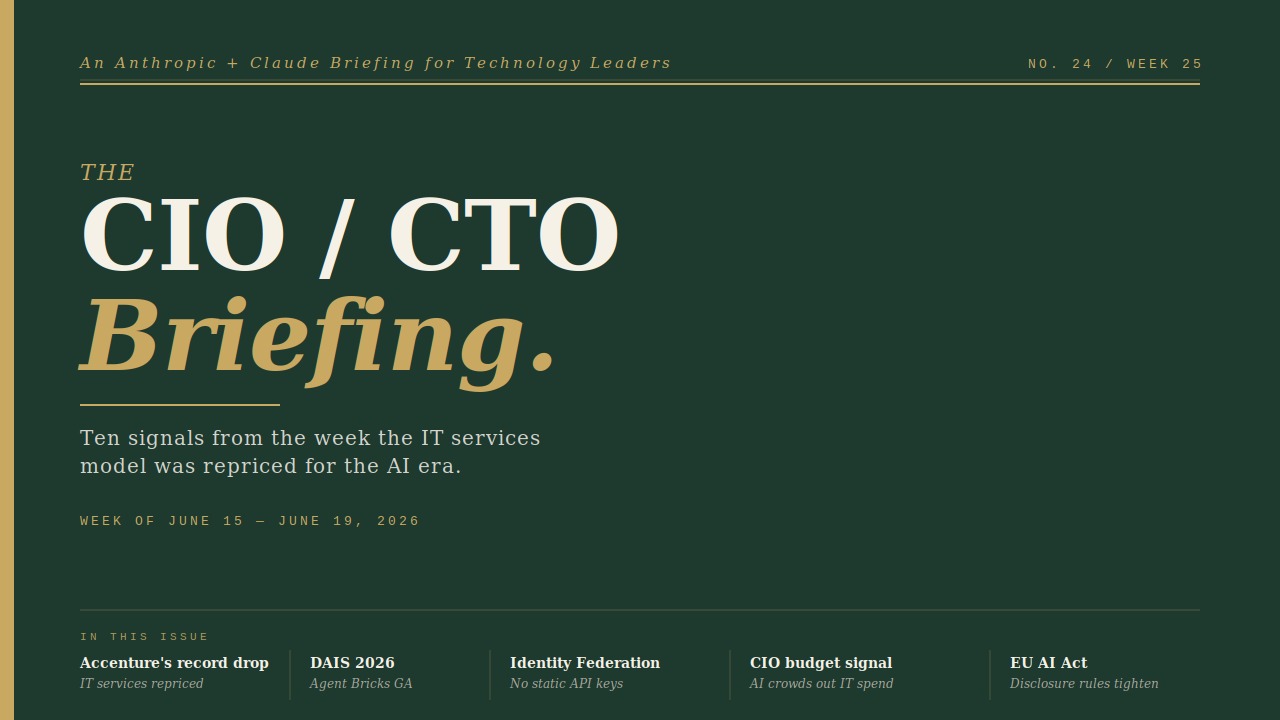
𝗧𝗵𝗲 𝗖𝗜𝗢 / 𝗖𝗧𝗢 𝗕𝗿𝗶𝗲𝗳𝗶𝗻𝗴: 𝟭𝟬 𝗦𝗶𝗴𝗻𝗮𝗹𝘀 𝗘𝘃𝗲𝗿𝘆 𝗧𝗲𝗰𝗵𝗻𝗼𝗹𝗼𝗴𝘆 𝗟𝗲𝗮𝗱𝗲𝗿 𝗦𝗵𝗼𝘂𝗹𝗱 𝗞𝗻𝗼𝘄
Week of June 15 to June 19, 2026 by Dr. Harish Kotadia, Ph.D.
This was the week the IT services model got repriced. Accenture posted its worst single-day stock drop on record after a guidance cut, Databricks turned its summit into a full enterprise agent platform launch, and the governance plumbing for production AI quietly shipped at three different vendors. If you sit at the CIO or CTO table, here is what matters this week and why.
- 𝗜𝗧 𝗦𝗲𝗿𝘃𝗶𝗰𝗲𝘀 𝗥𝗲𝗽𝗿𝗶𝗰𝗶𝗻𝗴 — Accenture posts worst single-day stock drop on record after AI guidance cut
On June 18 Accenture beat EPS by nine cents but shares fell as much as 20 percent — the worst single-day decline on record — after the company narrowed FY2026 revenue growth to 3 to 4 percent (from 4 to 7 percent) and posted a 2 percent decline in new bookings. Cognizant fell 5.6 percent, Infosys ADRs dropped close to 10 percent, IBM fell 4 percent, and the Nifty IT index sank 6 percent. The thesis change that matters for CIOs: AI spending is crowding out other IT budget rather than expanding it.
Link: https://www.cnbc.com/2026/06/18/accenture-q3-earnings-guidance-cut.html
- 𝗣𝗹𝗮𝘁𝗳𝗼𝗿𝗺 𝗦𝘁𝗿𝗮𝘁𝗲𝗴𝘆 — Databricks Data + AI Summit ships Agent Bricks GA with Unity AI Gateway
Databricks DAIS 2026 (June 15 to 18, Moscone Center, 30,000 plus attendees) turned Agent Bricks into a full enterprise agent platform: any framework (LangGraph, PyFunc, others), any model (Claude, OpenAI, Gemini, Qwen, and as of June 18 also xAI Grok), deployed as managed Databricks Apps on serverless compute, all governed through the new Unity AI Gateway. Genie Code, Lakebase, and Lakeflow Designer also reached GA. The platform-level claim: lakehouse, semantic layer, agent runtime, and governance are now one stack.
Link: https://www.databricks.com/blog/agent-bricks-dais-2026
- 𝗖𝗜𝗢 𝗕𝘂𝗱𝗴𝗲𝘁 𝗦𝗶𝗴𝗻𝗮𝗹 — Morgan Stanley CIO survey shows AI crowding out other IT spend
Morgan Stanley downgraded Accenture this week, citing first-quarter CIO survey data showing IT services budgets expected to grow only about 2 percent in 2026 against overall IT budget growth of 3.7 percent. The bank cut its FY2027 revenue growth forecast and dropped the valuation multiple to 12x earnings from 16x. For technology leaders, the implication is concrete: the AI line item is consuming the increase, not adding to the total. Plan accordingly when negotiating your FY2027 services agreements.
Link: https://finance.yahoo.com/sectors/technology/articles/accenture-downgraded-morgan-stanley-ai-174036267.html
- 𝗘𝗻𝘁𝗲𝗿𝗽𝗿𝗶𝘀𝗲 𝗦𝗲𝗰𝘂𝗿𝗶𝘁𝘆 — Anthropic ships Workforce Identity Federation and service accounts for Claude Platform
Anthropic introduced Workforce Identity Federation (WIF) and service accounts on the Claude Platform this week: no static API credentials to create, rotate, or leak. Workloads authenticate with the identity they already have — AWS IAM role, GCP or Kubernetes service account, Azure managed identity, GitHub Actions token, Okta, or any OIDC-compliant provider. Each workload gets its own service account with scoped roles. This is the pattern your CISO has been asking for since you first added Claude to the stack.
Link: https://releasebot.io/updates/anthropic
- 𝗠𝘂𝗹𝘁𝗶-𝗠𝗼𝗱𝗲𝗹 𝗦𝘁𝗿𝗮𝘁𝗲𝗴𝘆 — xAI Grok lands on Databricks Agent Bricks
On June 18 xAI’s Grok models became natively available on Databricks Agent Bricks. With Grok now on Oracle Cloud, Azure AI Foundry, Amazon Bedrock, and Databricks, every major hyperscaler and data platform now hosts every major frontier model under zero-data-retention endpoints. For enterprise architects, this is the moment vendor lock-in shifts from model to platform: your differentiator is no longer which model you picked, but how clean your data and governance layer is.
Link: https://www.basenor.com/blogs/news/xai-grok-lands-on-databricks-at-the-2026-data-ai-summit
- 𝗣𝗿𝗼𝗱𝘂𝗰𝘁𝗶𝗼𝗻 𝗠𝗶𝗴𝗿𝗮𝘁𝗶𝗼𝗻 — Original Claude Sonnet 4 and Opus 4 retired from the API on June 15
The 60-day deprecation window closed this week. Any API calls to claude-sonnet-4-20250514 or claude-opus-4-20250514 now return errors with no grace period. Recommended targets are claude-sonnet-4-6 and claude-opus-4-8 respectively. One catch worth flagging to your platform team: Opus 4.8 dropped support for manually setting temperature, top_p, and top_k (inherited from 4.7). Hardcoded sampling parameters will return 400 errors. Replace with prompting.
Link: https://docs.claude.com/en/release-notes/overview
- 𝗩𝗲𝗻𝗱𝗼𝗿 𝗣𝗿𝗶𝗰𝗶𝗻𝗴 — Anthropic pauses planned Agent SDK billing split
After announcing on May 14 that Claude Agent SDK and claude -p (headless) usage would exit Pro, Max, Team, and Enterprise subscription pools on June 15 and move to a separate metered credit, Anthropic confirmed on June 15 that the change is paused and is not taking effect. Programmatic and interactive usage continues to draw from the same pool. For CIOs running production agents on subscription plans, the immediate cost shock is off the table — but the underlying economics (a human runs dozens of prompts a day, an agent runs thousands) means a future pricing change is likely. Build cost telemetry now.
Link: https://www.digitalapplied.com/blog/anthropic-claude-credit-overhaul-june-15-2026
- 𝗪𝗼𝗿𝗸𝗳𝗼𝗿𝗰𝗲 𝗧𝗿𝗮𝗻𝘀𝗶𝘁𝗶𝗼𝗻 — Zuckerberg admits Meta’s AI restructuring made mistakes
In an internal memo dated June 12 and widely reported this week, Mark Zuckerberg acknowledged Meta had made mistakes in its AI-driven restructuring and that more were likely. Roughly 8,000 employees were laid off in May and another 7,000 transferred into AI initiatives — nearly 20 percent of the workforce affected. For technology leaders running their own AI-driven workforce transitions, the takeaway is candid: the largest, best-resourced AI company on the planet is openly saying it is not getting this right. Plan for iteration, not a single org redesign.
Link: https://www.dqindia.com/news/meta-layoffs-2026-ai-restructuring-zuckerberg-mistakes-12038953
- 𝗥𝗲𝗴𝘂𝗹𝗮𝘁𝗼𝗿𝘆 𝗖𝗮𝗹𝗲𝗻𝗱𝗮𝗿 — EU publishes Code of Practice on AI-generated content marking and labelling
The European Commission published the Code of Practice on transparency of AI-generated content on June 10 and continued the rollout through the week, with the State of the Digital Decade 2026 report (June 17) reinforcing the regulatory trajectory. Colorado’s comprehensive AI legislation takes effect June 30. For CIOs serving EU customers or operating in regulated US states, the disclosure obligations are concrete and short-fused. Audit your content pipelines for provenance metadata now.
Link: https://digital-strategy.ec.europa.eu/en/policies/regulatory-framework-ai
- 𝗖𝗜𝗢 𝗥𝗲𝘀𝗲𝗮𝗿𝗰𝗵 — Info-Tech mid-year report finds AI execution pushing CIOs back to IT fundamentals
Info-Tech Research Group’s Best of 2026 Mid-Year Report (June 17) and Info-Tech LIVE 2026 (June 9 to 11, results published this week) found that AI value depends less on model choice and more on the foundations underneath: stronger data practices, modern infrastructure, integrated risk and governance, workforce readiness, and disciplined technology buying. Stanford’s 2026 AI Index found 62 percent of organizations cite security and risk as the primary barrier to scaling agentic AI — 24 points ahead of any other constraint. The bottleneck is governance, not capability.
Link: https://www.prnewswire.com/news-releases/ai-execution-is-pushing-cios-back-to-it-fundamentals-info-tech-research-group-s-best-of-2026-mid-year-report-finds-833423848.html
© Dr. Harish Kotadia, 2026. All Rights Reserved.
Dr. Harish Kotadia, Ph.D., is an Enterprise AI Architect with 20+ years of IT consulting experience serving Fortune 100 clients, specializing in agentic AI systems built on Anthropic Claude, AWS Bedrock, and Google Vertex AI. He holds a Ph.D. in Marketing Management with doctoral research in marketing analytics. Follow him at @agenticaiarch on X and at AgenticAIArch.com.