
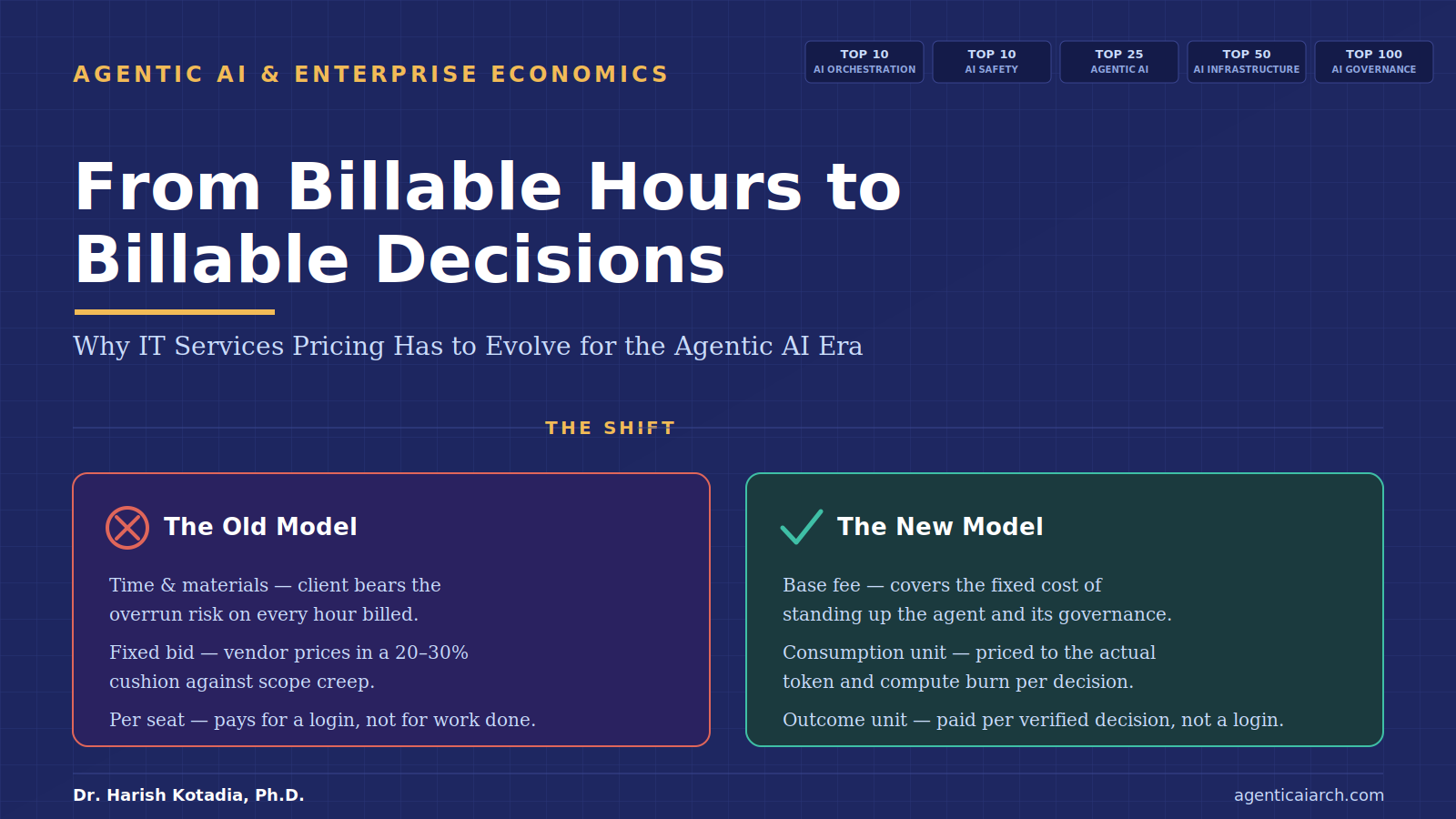
A price-per-decision model charges for a completed unit of agentic work — a resolved case, a closed loop — instead of the hours it took a person to get there or the seats a company happened to buy. That’s the short version. The longer version: this isn’t really a pricing change. It’s an admission that the thing being sold has changed, and most of the industry hasn’t said so out loud yet.
I’ve spent twenty years watching IT services get priced two ways, dressed up in different clothes. Time and materials: bill the hours, client eats the overrun risk. Fixed bid: quote the scope, vendor eats the risk, and prices in a 20–30% cushion for the privilege. Software vendors added a third lane — pay per seat, regardless of whether that seat did five things or five hundred. All three assume the cost of producing the work is roughly stable per hour, per person, per user. Agentic AI breaks that assumption.
The assumption nobody priced for
An agent doesn’t cost the same to run twice. A multi-step reasoning task can burn five to thirty times more tokens than a simple chatbot query, per one analyst firm’s March 2026 note. Per-token prices have fallen roughly 280x to 600x in a few years, yet enterprise AI spend still tripled in a single year — $11.5 billion to $37 billion. Cheaper unit cost, bigger total bill — that’s Jevons Paradox, and it’s why I wrote that compute is not a fixed line item. The cost of a decision is emergent, not forecastable — no rate card built for stable hourly costs was designed to absorb that.
T&M can’t price this because the client can’t bound the burn. Fixed bid can’t either — you can pad a bid for scope creep, not for a model deciding it needs four reasoning passes instead of one. And per-seat licensing fails for a simpler reason: when ten agents do what a hundred people used to, logins stop correlating with work done. One widely circulated SaaS commentary makes the point sharply — the seat was never really the thing being sold. Headcount was always a stand-in for output, and agentic systems took the stand-in away.
What’s already happening
This isn’t hypothetical. One buyer survey of 838 enterprise respondents found outcome-based pricing reached 21.7% of contracts in early 2026 — parity with per-user pricing for the first time on record. A separate buyer report says more than one in three buyers now prefer variable pricing over a flat subscription.
Some vendors have already committed to a number:
- Intercom’s Fin charges $0.99 per resolution, stacked on seat plans from ~$29.
- Sierra runs pure outcome pricing with no public rate card — third parties estimate ~$1.50 per resolution. Reported ARR doubled to $200 million in a year at a $15.8 billion valuation, and its newest product stretches the billable unit into multi-week outcomes rather than shrinking it.
- Salesforce Agentforce has run three pricing models in eighteen months — $2 per conversation, Flex Credits at ten cents an action, then per-user licensing marketed as “digital labor.” I don’t read that as indecision. I read it as a vendor discovering that no single unit fully captures what buyers will pay for.
- HighRadius went furthest: zero seat fees, zero fees until go-live, then a share of value delivered.
If a vendor with Salesforce’s pricing sophistication needed three tries to find something buyers would sign, imagine how much harder this gets for a services engagement where the “outcome” is a multi-week transformation, not a single ticket.
On the services side, the shift is showing up in earnings calls more than press releases. Nearly every major global IT services firm has used the phrase “outcome-based” or “consumption-based” in the past year. One large business-process firm now reports close to half its revenue from non-headcount-linked, IP-based sources — already on the P&L, not just in the strategy deck.
Why this breaks the pyramid, not just the invoice
The staffing pyramid was never really an org chart. It was a financing structure — juniors did the billable work that trained them into seniors, and clients paid for that training through the hourly rate. Take that work away and you don’t just save money; you break the mechanism that grows your next generation of seniors. Cut the base too fast and you save margin for three years, then discover nobody knows how to do the senior work either — because nobody spent five years learning it. One breakdown of this dynamic shows it’s already visible in entry-level hiring data. Meanwhile the big consultancies keep circling toward performance-based fees — one leading strategy firm has said publicly that roughly a quarter to a third of its global fees are now tied to performance, not hours.
The framework that is coming
The destination isn’t pure price-per-decision, even for the vendors pushing hardest toward it. What’s coming is a layered model:
| Layer | What it covers | Why it exists |
|---|---|---|
| Base / platform fee | Fixed cost of standing up the agent, integrations, governance | Protects the vendor’s floor cost regardless of volume |
| Consumption unit | Tokens, API calls, agent actions | Reflects the actual variable cost driver |
| Outcome unit | Price per resolved case or verified decision | The unit the buyer actually values |
| Risk/assurance premium | Governance, audit trail, escalation coverage | Prices the cost of proving the decision was correct |
That fourth row is the one nobody’s pricing yet, and I think it ends up mattering more than the other three combined. A price-per-decision contract only works if both sides agree on what counts as a decision — and right now that definition does a lot of quiet work in the vendor’s favor. If a resolution is counted the moment a customer goes quiet rather than the moment the problem is solved, the incentive is to maximize declared resolutions, not real ones. I’ve seen this called “the most expensive myth in enterprise AI,” and I don’t think that’s overstating it. Outcome pricing without an audit trail isn’t outcome pricing — it’s a shell game with an invoice attached.
This is where governance work — the kind I’ve spent this year building into a scoring framework — stops being a nice-to-have and becomes what makes the pricing model possible at all. You can’t charge per decision if you can’t prove one happened correctly, inside its assigned boundary.
What I’d actually do about it
If I ran pricing at an IT services firm, I wouldn’t sign an outcome-based contract before I could answer one question with real numbers: what does one unit of agentic work cost me, fully loaded, including the reasoning passes that failed before the one that succeeded? Most firms can’t answer that yet — instrumentation is lagging the sales pitch.
If I were the buyer, I’d want a written, binary, hard-to-game definition of what counts as a resolved decision, an independently auditable usage ledger, and a cap that doesn’t silently shift overflow onto a human team when the meter runs hot. Predictability isn’t nostalgia for the old model — it’s a legitimate requirement. The firms that survive this will be the ones that sell predictability and outcome pricing in the same contract, not as opposites.
The rate card isn’t dying because hours went out of fashion. It’s dying because the thing being billed no longer behaves like labor — it behaves like a variable-cost decision engine, and pricing it like labor was always a temporary accommodation.
Related reading on my site: definition of agentic AI, five-stage agentic AI roadmap, and library of enterprise agentic AI case studies. My governance methodology in full is in Earned Autonomy, available on Kindle.
© Dr. Harish Kotadia, Ph.D., All Rights Reserved, 2026.
Dr. Harish Kotadia, Ph.D., is an Enterprise AI Architect with 20+ years of IT consulting experience serving Fortune 100 clients, specializing in agentic AI systems built on Anthropic Claude, AWS Bedrock, and Google Vertex AI.
Disclaimer: This blog post is based on recent events and news items drawn from reputed media sources and vendor websites available in the public domain and quoted above. This post is intended for educational purposes, to help the enterprise agentic AI community learn from public information on the application and use of agentic AI tools and technology in Fortune 500 companies.
Views and opinions expressed here are my own and do not represent those of any employer or client, past or present. The analysis presented is my independent interpretation of published news reports quoted above and does not constitute legal, financial, or consulting advice of any kind.