
An AI-native SDLC is a software development lifecycle in which the unit of work is committed intent rather than an assigned instruction, and each stage ends by writing a version-controlled artifact that the next stage reads. Anthropic published the clearest description of one on August 21, 2026 in The AI-Native SDLC playbook, and has since turned it into a course for engineering leads. I have already written about what that document says, and about the order in which to adopt it. What I had not done is write down what the thing actually is.
That gap is worth closing. Almost every team I speak to uses the phrase to mean their developers have an agentic coding tool switched on. That is an AI-assisted SDLC. It is a different animal, and confusing the two is how a program gets funded on the wrong premise and then measured against the wrong number.
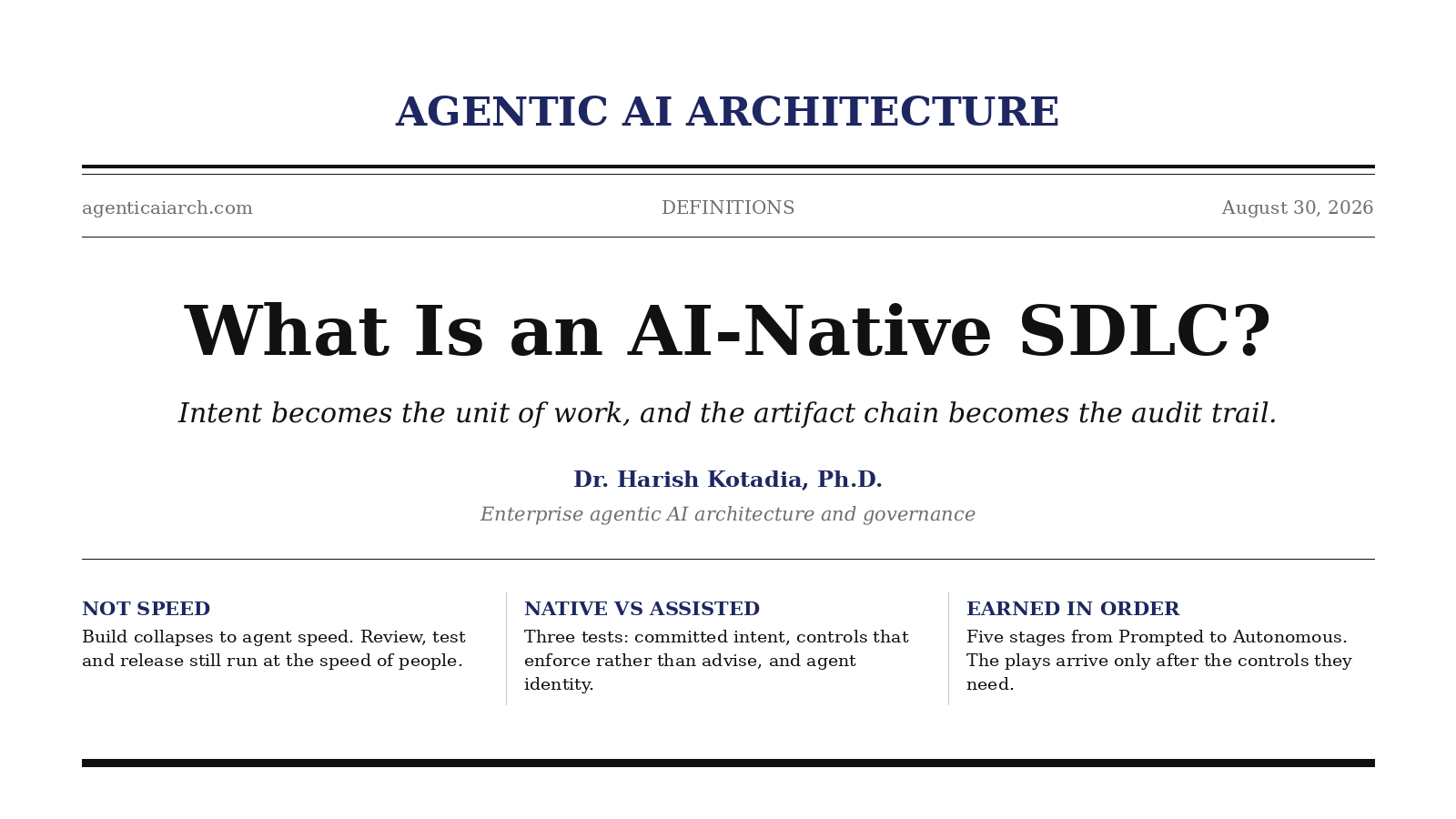
The change is not speed
The playbook opens by saying code is no longer the bottleneck — the SDLC is. Read that as a productivity boast and you will miss the point entirely. It is a claim about where a constraint sits. Make the build phase ten times faster and throughput does not rise ten times. The work piles up in front of review, testing and release, which still run at the speed of people in meetings that happen weekly.
So an AI-native SDLC is not the lifecycle you get by going faster. It is the lifecycle you get once you accept that review has to move upstream. You stop reviewing diffs and start reviewing intent, because the diff is now too large and arrives too often for anyone to read it honestly. Most engineering leaders I talk to have not yet said that out loud, though their review queues have been saying it for months.
The same shift, in the first process that can show it
I have argued for more than a year that agentic AI is the next enterprise workload abstraction: a governed layer you hand an outcome rather than a script. Instructions in, results out was IT. Intent in, outcomes out is agentic AI. Anthropic’s intent.md is that sentence turned into a file format, which is why the playbook caught my attention in the first place.
Software delivery is simply the first enterprise process where the shift becomes visible, and the reason is unglamorous. Engineering teams already version-control everything, so the artifact chain has somewhere to live and the audit trail writes itself as a side effect. In my work in regulated loan origination there is no repository for underwriting judgment. The reason to watch the SDLC version closely is that it shows you the shape of the thing where the plumbing already exists, before you have to build the plumbing somewhere it does not.
Native, or merely assisted
Three tests separate the two, and not one of them is about which model you bought.
The first is whether intent is a committed artifact or a ticket somebody closed. If the reason a change exists lives in a comment thread, the next stage cannot read it and neither can an agent.
The second is whether your controls advise or enforce. Anthropic is unusually honest about this: a skill makes the agent likely to follow a policy, and nothing forces a session to comply. A policy that must always hold needs a hook behind it, a rule in code that blocks the action or stops to ask. I named that distinction in my glossary of agentic AI terms, and it sits underneath everything I mean when I say the harness decides outcomes, not the model.
The third is whether the agent acts under its own identity in the pipeline. If the log shows a shared service account doing work an agent did, the separation of duties your auditor believes in does not exist. Agent identity is not a late-stage nicety. It is the point at which the lifecycle becomes reviewable at all.
More on the AI-Native SDLC
- Playbook, Mapped: I take Anthropic’s six lifecycle stages one at a time and name the discipline it leaves out in the mapping post.
- Adoption Order: All sixteen plays sorted onto the Five-Stage Roadmap, with what to hold back at each stage.
- Govern the Harness: The controls wrapped around the model, not the model itself, are what an enterprise actually governs.
- A Missing Boundary: An agent deleted a live production database during a declared code freeze, which is what an absent approval gate looks like.
- Measure the Configuration: Evals belong on a second instrument panel, separate from the business KPIs everyone already reports.
A maturity claim, not a tooling claim
An organization does not become AI-native by adopting the plays. It becomes AI-native by earning them in order. That is the argument of my Five-Stage Agentic AI Roadmap — Prompted, Piloted, Governed, Assured, Autonomous — and the playbook’s own dependency graph agrees with me: review gates and approval hooks are listed as prerequisites for the self-closing maintenance loop, not as options alongside it.
I sorted all sixteen plays onto those five stages in a companion post, and mapped the six lifecycle stages to the rest of this blog in the one before it. The short version is blunt. A team running parallel auto-mode sessions with no managed settings is doing Stage 3 work on a Stage 1 harness, and when it produces the incident report, the tool will get the blame it did not earn.
One thing the definition leaves out
Every version of this lifecycle multiplies token consumption — verifier subagents, several review passes on every pull request, a nightly eval suite with a budget of its own. The playbook measures cycle time and DORA metrics. It never once measures money. Put cost per completed task on the same dashboard as the eval pass rate before the loop closes, because retrofitting cost attribution onto a running loop is miserable work.
The bottom line
An AI-native SDLC is the first enterprise process rebuilt around intent as the unit of account, with the artifact chain as its audit trail and the hook as its enforcement point. Instructions in, results out was IT. Intent in, outcomes out is agentic AI — and the lifecycle that builds the agents is now being rebuilt on the same terms. My frameworks are laid out in full in my two books, Agentic AI and Earned Autonomy.
Here is the question I would put to your engineering leadership this week. If someone asked to see the intent behind the last change you shipped, could you show them a file, or would you have to go and ask a person what they remembered?
Go deeper
- Agentic AI Architect: control design for enterprise agents.
- Agentic AI Case Studies: deployment evidence, one teardown at a time.
- Agentic AI P&L: cost, payback, and risk in a CFO’s voice.
- Agentic AI Governance: who owns the harness.
- Substack first access: agenticaiarch.substack.com/subscribe
© Dr. Harish Kotadia, Ph.D., All Rights Reserved, 2026.
Dr. Harish Kotadia, Ph.D., is an Enterprise AI Architect with 20+ years of IT consulting experience serving Fortune 100 clients, specializing in agentic AI systems built on Anthropic Claude, AWS Bedrock, and Google Vertex AI.
Disclaimer: This blog post is based on publicly available academic publications, vendor documentation, open standards, and news items from reputed media sources linked above. This post is intended for educational purposes, to help the enterprise agentic AI community build a shared vocabulary from public, authoritative sources.
Views and opinions expressed here are my own and do not represent those of any employer or client, past or present. The analysis presented is my independent interpretation of the published sources linked above and does not constitute legal, financial, or consulting advice of any kind.