
Category: Agentic AI SDLC
-
Agentic AI Layoffs: Greatly Exaggerated, Ask the Scribes

The press put the scribes out of work and the book trade grew tenfold. The Fed, the BLS, Gartner and Anthropic’s own data say the agentic AI layoffs story is bigger than the layoffs.
-
AI Adoption in IT Services: Sell Judgment, Not Hours
Anthropic’s agents now log six hours for every human hour. For IT firms that bill by the hour and grow by hiring graduates, that changes pricing, staffing and who signs the work.
-
AI Impact on IT Jobs: Skills Move, Adapters Win
Developer job postings are up even as AI writes more code. History shows the same pattern every time: the skill moves, and the people who move with it win.
-
Agentic AI Pilot to Production: A Gate, Not a Graph
Two out of three agentic AI projects never leave the pilot stage. The firms that ship treat production as a gate you earn, not a graph you buy.
-
Internal AI Agents: Fix the Permissions First
Large companies are scaling internal AI agents first and the ones that work share one habit: they cleaned up permissions before the first connection, not after the first incident.
-
Agentic AI Insider Risk: It Is Governance, Stupid, Not the LLM
Satya Nadella just said to treat every AI model as an insider risk. I agree, and I map his seven principles to the controls I already use, with one contained and one catastrophic deployment.
-
Agentic AI Harness Drift: Version the Harness Like a Model

You cannot claim change control because you pinned a model version. You can claim it when the harness itself is an inventoried, versioned, eval-gated artifact.
-
Agentic AI Contract Renegotiation: Renegotiate Before Renewal

Agents changed the work under your vendor contracts, but the invoice didn’t change. Agentic AI contract renegotiation resets price, risk and oversight before renewal.
-
Agentic AI Definition of Done: Done Is a Pass Rate
An agentic AI definition of done is a measured pass rate on real tasks, signed by one named person. Three anonymized cases show what happens with and without one.
-
Agentic AI Change Management: A Prompt Edit Is a Production Change

Agentic AI change management treats every prompt, model and tool edit as a production release. Here is what counts as a change and how I gate it.
-
Agentic AI Liability: Who Owns the Agent’s Decision?
An agent can follow every rule and still get it wrong. Here is who carries the loss, how far a vendor contract really helps, and the evidence that protects you.
-
Agentic AI Code Review: Intent, Not Diff
What is agentic AI code review? Agentic AI code review is how a team checks code that an agent wrote before it ships. The human stops reading every line and reviews the intent, the evals and the scope of the change, while review agents scan the diff first. One thing stays fixed: a named person…
-
Agentic AI Statement of Work: Outcome, Not Effort
What is an agentic AI statement of work? An agentic AI statement of work is the contract that says what an agent-run system must deliver and how acceptance is measured. It also sets the autonomy level and names who signs for each control. A traditional SOW buys effort, but this one buys an outcome with…
-
Agentic AI RACI Matrix: Governance Owns the Autonomy
What is an agentic AI RACI matrix? An agentic AI RACI matrix is a one-page chart for an agentic AI project. It names who is Responsible, Accountable, Consulted and Informed for every activity in the lifecycle. The chart runs from the first intent statement to the decision to expand or roll back autonomy. It differs…
-
Agentic AI SDLC Best Practices: Close the Loop Before You Leave
What are agentic AI SDLC best practices? Agentic AI SDLC best practices are the working rules for a lifecycle where an agent reads the code, plans, edits, runs commands and checks its own work. A human watches, redirects or walks away. Most of them come down to one constraint: the agent’s context window fills fast,…
-
Agentic AI SDLC vs Traditional SDLC: What Changes
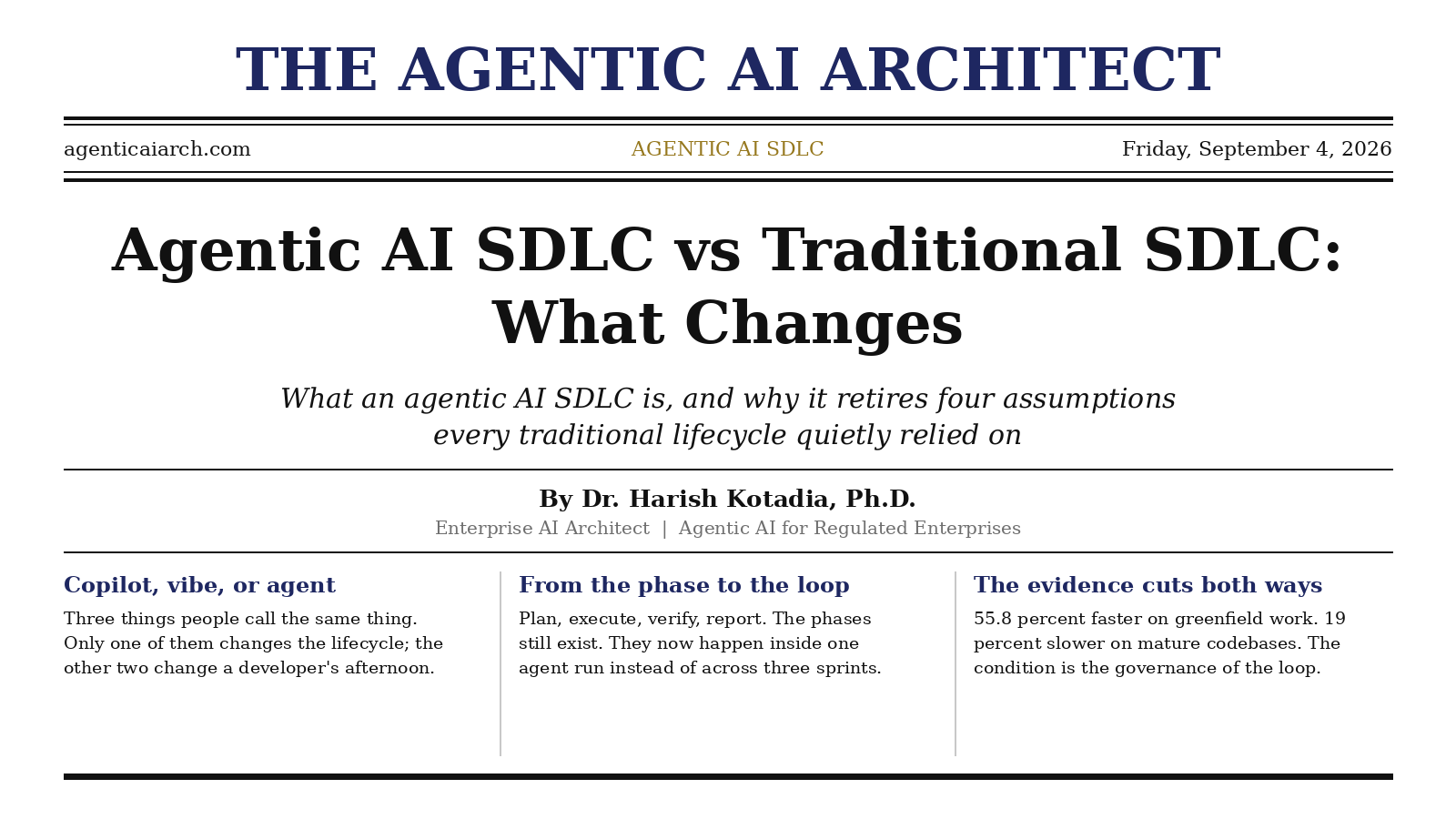
An agentic AI SDLC is a software development lifecycle in which AI agents, not developers, execute the work inside each phase, and humans move to setting intent, approving plans, reviewing outcomes and governing the loop. That one sentence is the whole difference from the lifecycle most enterprises still run. In a traditional SDLC a person…